
Pluto Memes

Posts tagged with Pluto
Relationships With Moons

Relationships With Moons
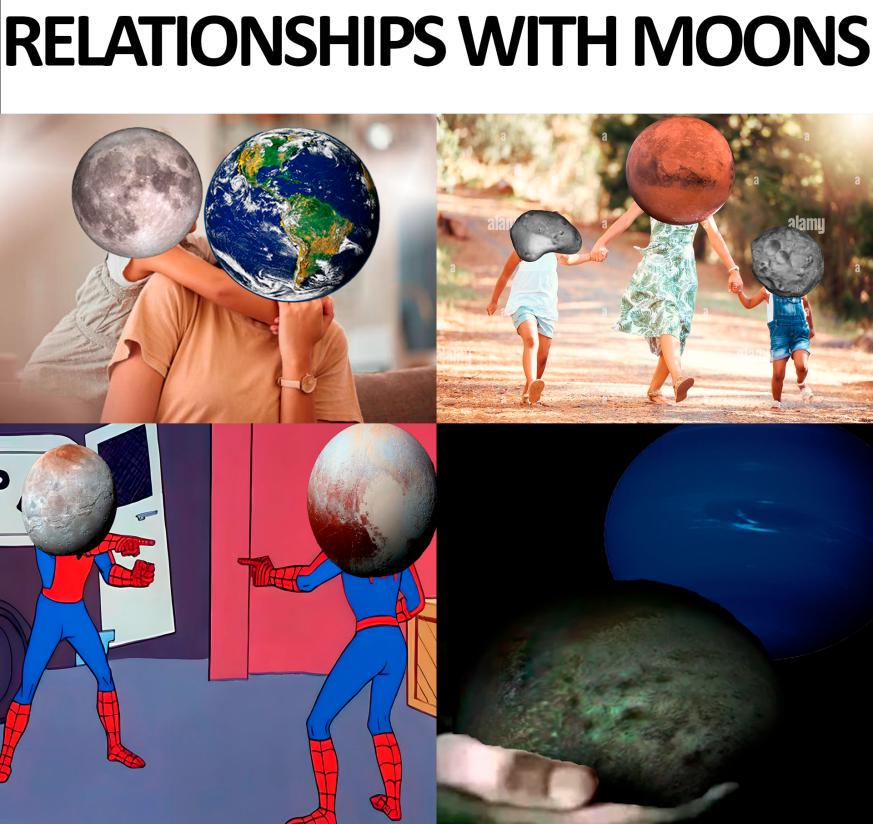
Earth and Luna up top looking like a stable, healthy couple that's been together forever. Then Mars showing up with Phobos and Deimos like a proud parent at a school play—wholesome vibes all around. But then we get to Pluto and Charon doing the Spider-Man pointing meme because they're actually in a binary system where they both orbit a common center of mass BETWEEN them. They're basically equals arguing about who's the moon. And finally, Neptune just casually flexing with Triton, its absolutely massive retrograde moon that it probably yoink'd from the Kuiper Belt like a cosmic kidnapper. Triton's out here being the only large moon in the solar system with a retrograde orbit, slowly spiraling toward Neptune in a doomed gravitational death dance. Talk about a complicated relationship status.

The Solar System Be Like

The Solar System Be Like
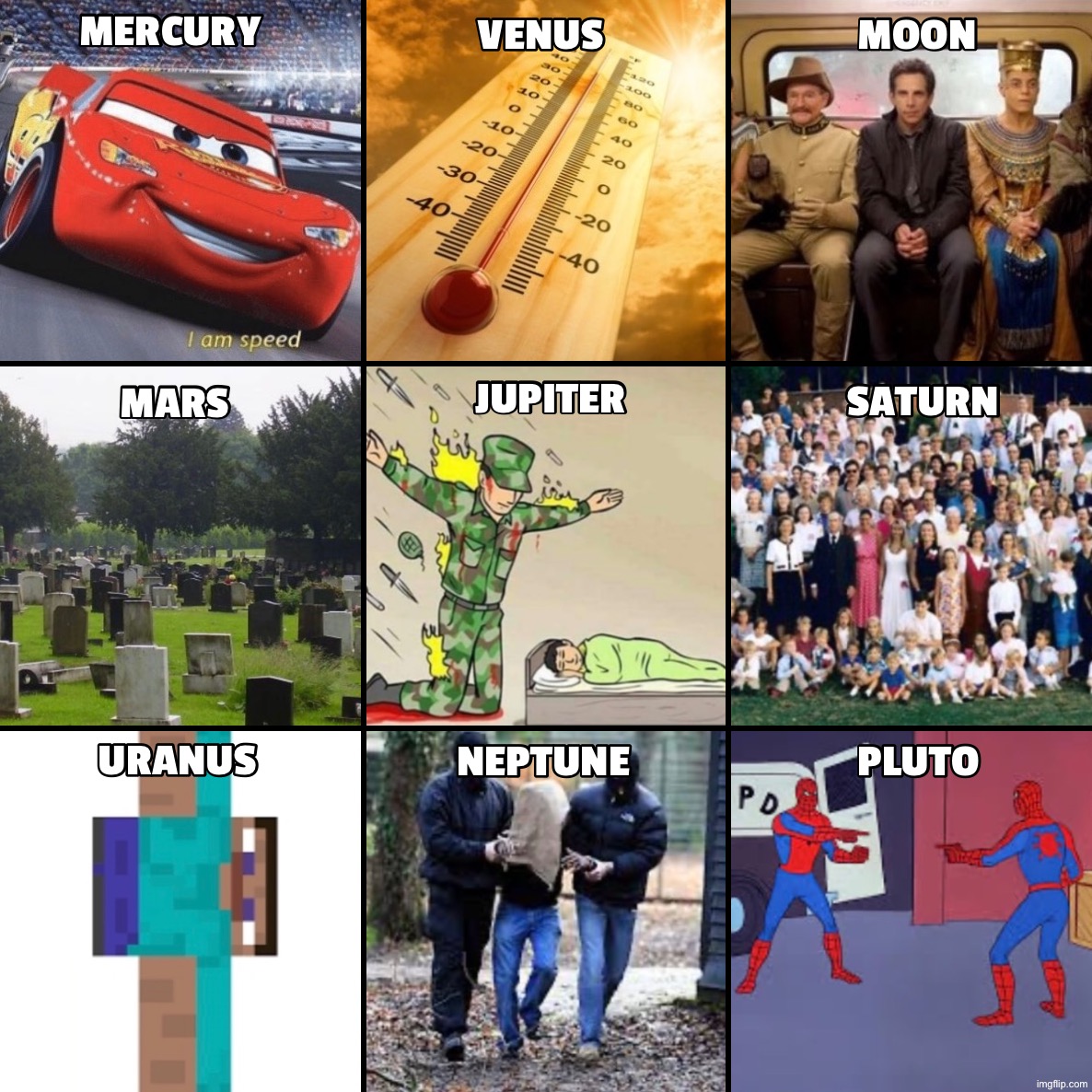
This meme absolutely nails the personality of each celestial body in our cosmic neighborhood. Mercury zooming around the Sun at 47 km/s? Lightning McQueen energy. Venus hitting 471°C with a crushing CO₂ atmosphere? That thermometer doesn't stand a chance. The Moon getting its historical trio of visitors (cowboy, scientist, pharaoh—representing different eras of humanity) is chef's kiss. Mars as a graveyard is painfully accurate—RIP to all those landers and rovers we've crashed there. Jupiter absolutely wrecking everything with its 95 Earths worth of mass while its moons just vibe in the background. Saturn showing off its 146 known moons like a proud parent at graduation. Uranus being... well, pixelated and awkward (because someone had to make the name joke). Neptune and its twin getting the Spider-Man pointing treatment since they're basically ice giant siblings. And Pluto? Still salty about that 2006 planetary demotion, pointing fingers at everyone who did it dirty. Each planet gets roasted based on its most defining characteristic, and honestly, they deserve it.

Have Fun Wandering The Milkomeda Forever Hades...

Have Fun Wandering The Milkomeda Forever Hades...
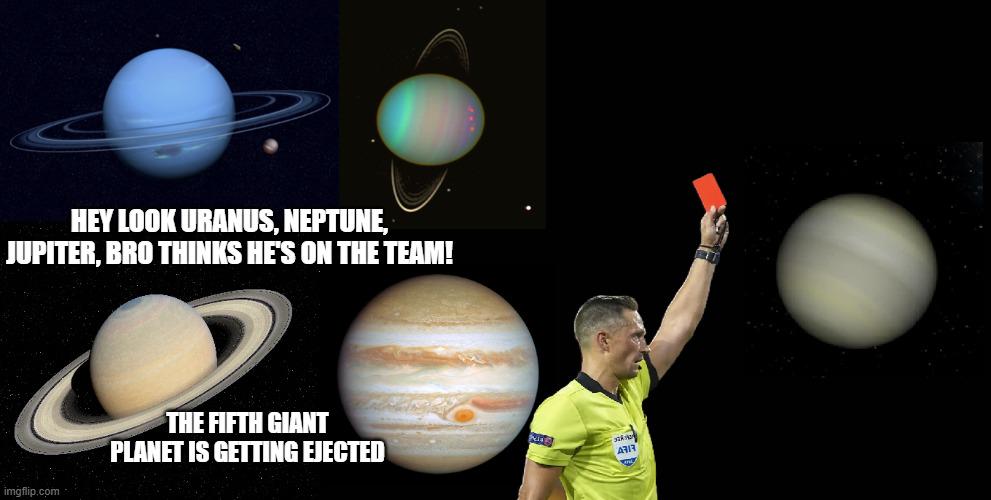
So the solar system's gas giants are literally kicking Pluto out of the club. Poor Pluto—first it gets demoted from planet status, and now it's getting a red card from the cosmic referee. The title references "Milkomeda," which is the future merged galaxy when the Milky Way and Andromeda collide in about 4.5 billion years. Basically, Pluto (Hades in Greek mythology) is being ejected so hard it'll be wandering the eventual Milkomeda galaxy for eternity. The "fifth giant planet" theory suggests there was once another ice giant in our solar system that got yeeted into interstellar space by gravitational interactions with Jupiter and Saturn. Looks like Pluto's about to join that cosmic exile. Neptune, Uranus, Jupiter, and Saturn are basically the popular kids deciding Pluto isn't cool enough for their gravitational neighborhood. Talk about adding insult to injury—not only are you not a planet anymore, but you're also getting ejected from the solar system entirely. At least Pluto will have billions of years to contemplate its life choices while drifting through the void.

Based On Vibes Alone

Based On Vibes Alone
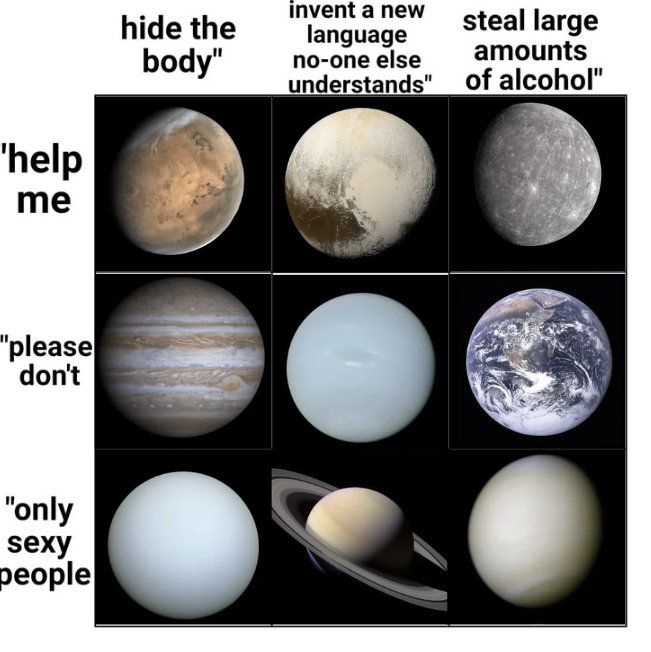
Planetary personality test results are in. Mars is clearly the murderer trying to hide evidence, while Pluto's that colleague who created their own notation system nobody can decipher. Mercury's just the office alcoholic. Meanwhile, Earth is desperately crying for help while Neptune and Venus are apparently only here to look pretty. Saturn's ring is basically just a cosmic fashion accessory at this point. Typical solar system dynamics—every family has one of each.

Population Of Celestial Bodies By Subreddit Size

Population Of Celestial Bodies By Subreddit Size
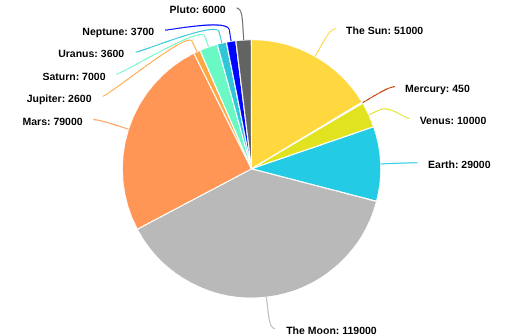
The internet has spoken, and apparently the Moon is the most popular celestial body in the solar system! This pie chart hilariously measures planetary "populations" by subreddit subscriber counts instead of actual scientific metrics. The Moon crushing everyone with 119,000 followers while poor Mercury sits at a measly 450 is peak internet astronomy. Notice how Mars has 79,000 - clearly all those rover photos and colonization dreams are paying off in the Reddit karma department! Meanwhile, Pluto still hanging in there with 6,000 loyal fans despite being demoted from planet status. The true cosmic hierarchy isn't determined by mass or orbital position, but by upvotes and meme potential!

Dwarf Planet Hierarchy Of Attention

Dwarf Planet Hierarchy Of Attention
The planetary status debate hierarchy in one perfect image. Pluto and its defenders frantically splashing around in the kiddie pool of astronomical discourse, while Eris quietly sits below, forgotten despite causing Pluto's demotion in the first place. Meanwhile, Ceres is basically a skeleton at the bottom of the ocean—a dwarf planet that's been dead to the conversation since 1801 when it was demoted from full planet status. The deeper you go in astronomical classification debates, the fewer people remain conscious.

Modern vs. Ancient Naming Conventions

Modern vs. Ancient Naming Conventions
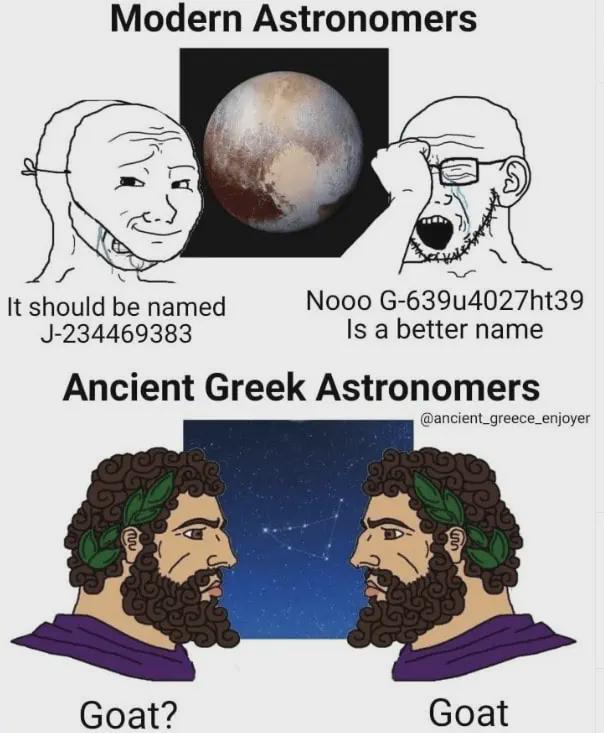
The celestial naming evolution is just *chef's kiss*. Modern astronomers are out here debating between alphanumeric soup (J-234469383) and keyboard-smash catalog numbers (G-639u4027ht39) for cosmic objects. Meanwhile, ancient Greeks just looked up at constellations and went "hmm, that's definitely a goat" and called it a day. The simplicity is beautiful! Those laurel-wearing dudes named entire star formations after animals and mythological figures while today's scientists need a spreadsheet to remember what they're looking at. The cosmic irony that despite our advanced technology, we've somehow made celestial nomenclature exponentially more complicated. Progress?

Outer Solar System House Party Gone Wrong

Outer Solar System House Party Gone Wrong
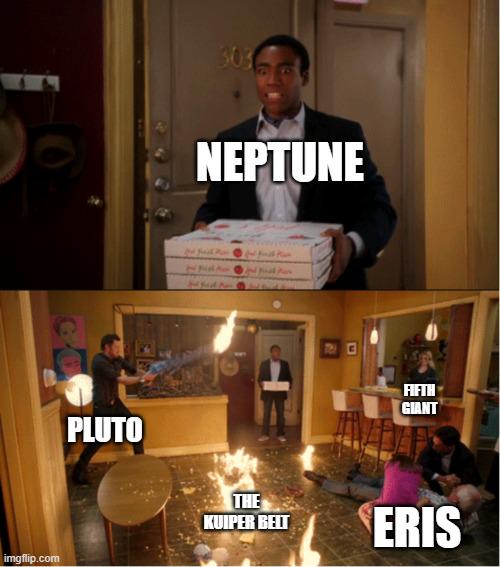
The solar system's outer neighborhood is pure chaos! This meme perfectly captures the icy drama of our distant planetary bodies. Neptune shows up like the responsible friend with pizza, only to find Pluto, Eris, and the entire Kuiper Belt having an absolute rager. It's basically what happens when you leave the tranquil inner solar system and venture into the cosmic wild west where dwarf planets are flinging ice chunks at each other and orbital resonances get completely ignored. Neptune's face says it all: "I'm 4.5 billion kilometers from the Sun and you guys are STILL causing problems?"

Cosmic Corporate Restructuring

Cosmic Corporate Restructuring
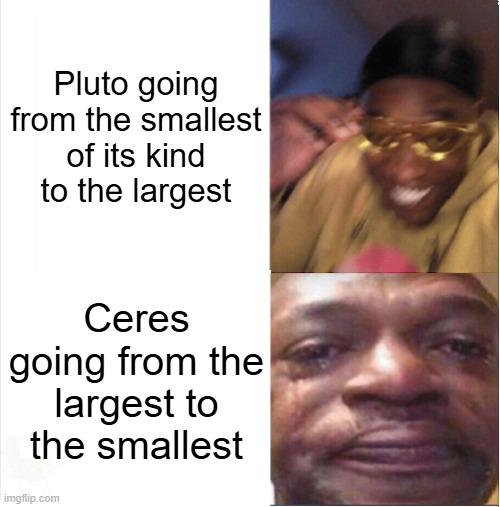
The celestial classification drama we didn't know we needed! In 2006, Pluto got demoted from planet to dwarf planet, going from the smallest planet to the largest dwarf planet - instant promotion in its new league! Meanwhile, poor Ceres got reclassified from asteroid to dwarf planet, dropping from queen of the asteroid belt to the runt of the dwarf planet family. It's basically cosmic corporate restructuring. Pluto's over there celebrating its new executive title while Ceres is clearing out its corner office. The universe's most dramatic org chart shake-up since the Big Bang!

If The Sun Is Bigger Than Pluto, Why Isn't Sun A Planet?

If The Sun Is Bigger Than Pluto, Why Isn't Sun A Planet?
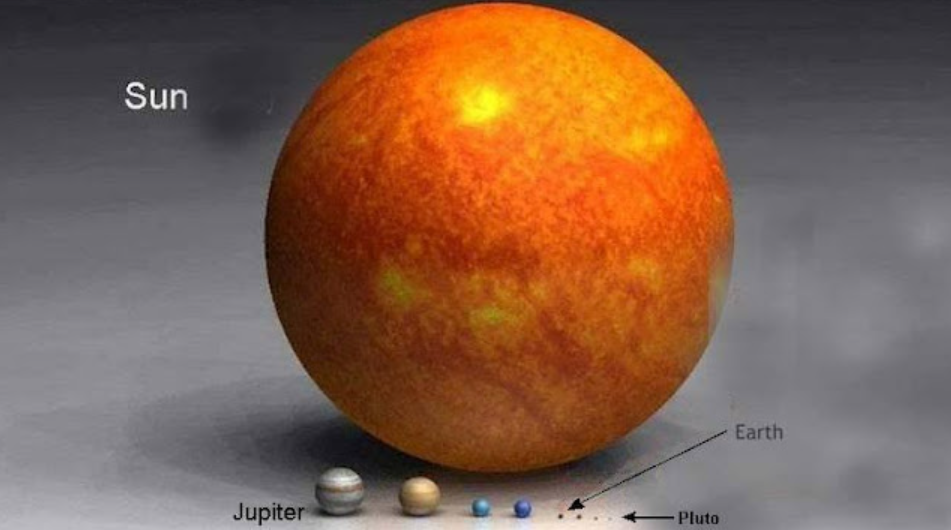
Someone's been skipping their astronomy lectures. The image shows an orange (labeled "Sun") next to some smaller fruits/objects (planets), with Pluto being practically microscopic. Size isn't the determining factor for planethood—otherwise my department head's ego would qualify as a celestial body. Stars are massive balls of plasma undergoing nuclear fusion, while planets are just rocky/gaseous objects orbiting stars. By this logic, I should ask why my coffee mug isn't classified as a teacup despite being larger than my colleague's teacup. The astronomy department would have a collective aneurysm reading this.

Size Doesn't Matter (In Planetary Classification)

Size Doesn't Matter (In Planetary Classification)
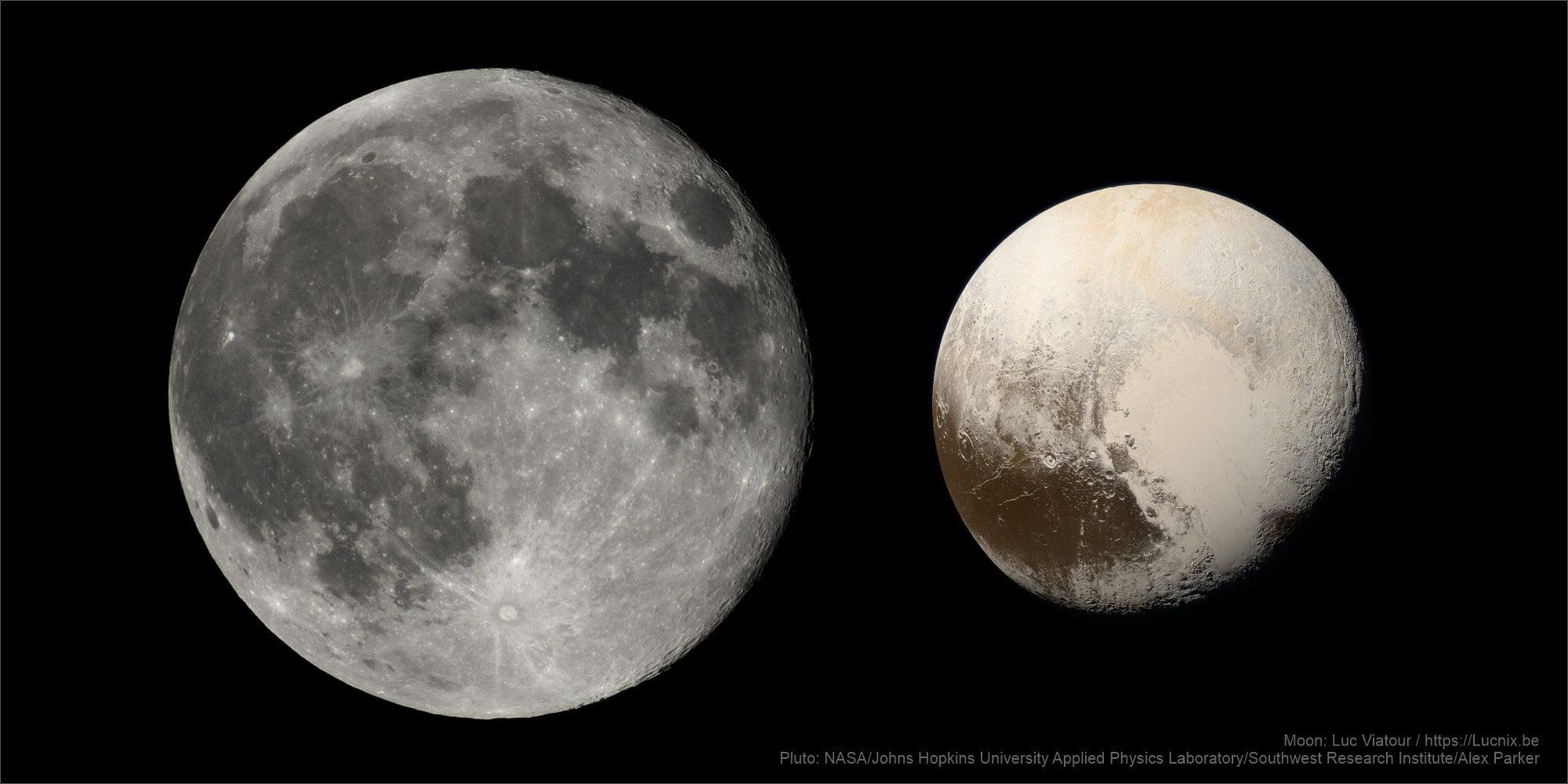
Size isn't everything in the cosmic popularity contest! Our Moon (left) is actually bigger than Pluto (right), but doesn't get the planet status because astronomy is basically celestial high school politics. 🌑 > 🪐 The truth? Planets need to "clear their neighborhood" of other objects in their orbit. The Moon is Earth's clingy sidekick that never bothered to dominate its own orbital path. Meanwhile, poor Pluto got kicked out of the planet club in 2006 for the same reason - it's like getting rejected from a party because your gravitational influence isn't cool enough. So next time someone asks why the Moon isn't a planet despite its size advantage over Pluto, just tell them: "It's not about the size of your celestial body, it's about how you use your gravitational influence!"

The Great Planetary Identity Crisis

The Great Planetary Identity Crisis
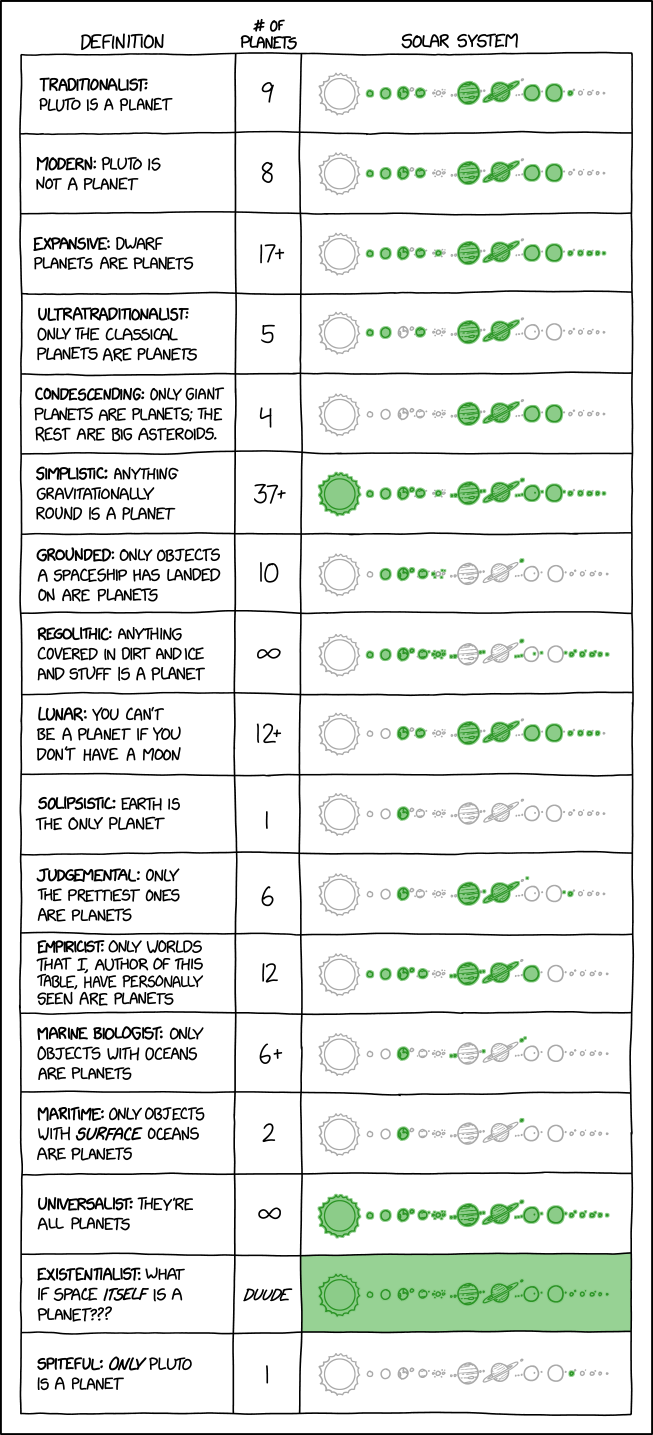
The planetary classification wars continue! This chart brilliantly satirizes how the definition of "planet" is surprisingly subjective. From the 2006 demotion of poor Pluto to the philosophical "what if space itself is a planet, duuude?" existentialist take. The "Spiteful" category is peak astronomy pettiness—counting only Pluto as revenge for its demotion. Meanwhile, the "Regolithic" definition would make practically everything a planet, because who doesn't have a little dirt and ice? My favorite has to be the "Empiricist" who only counts planets they've personally observed. Classic scientist move: "If I haven't seen it with my own eyes and equipment, does it really exist?"