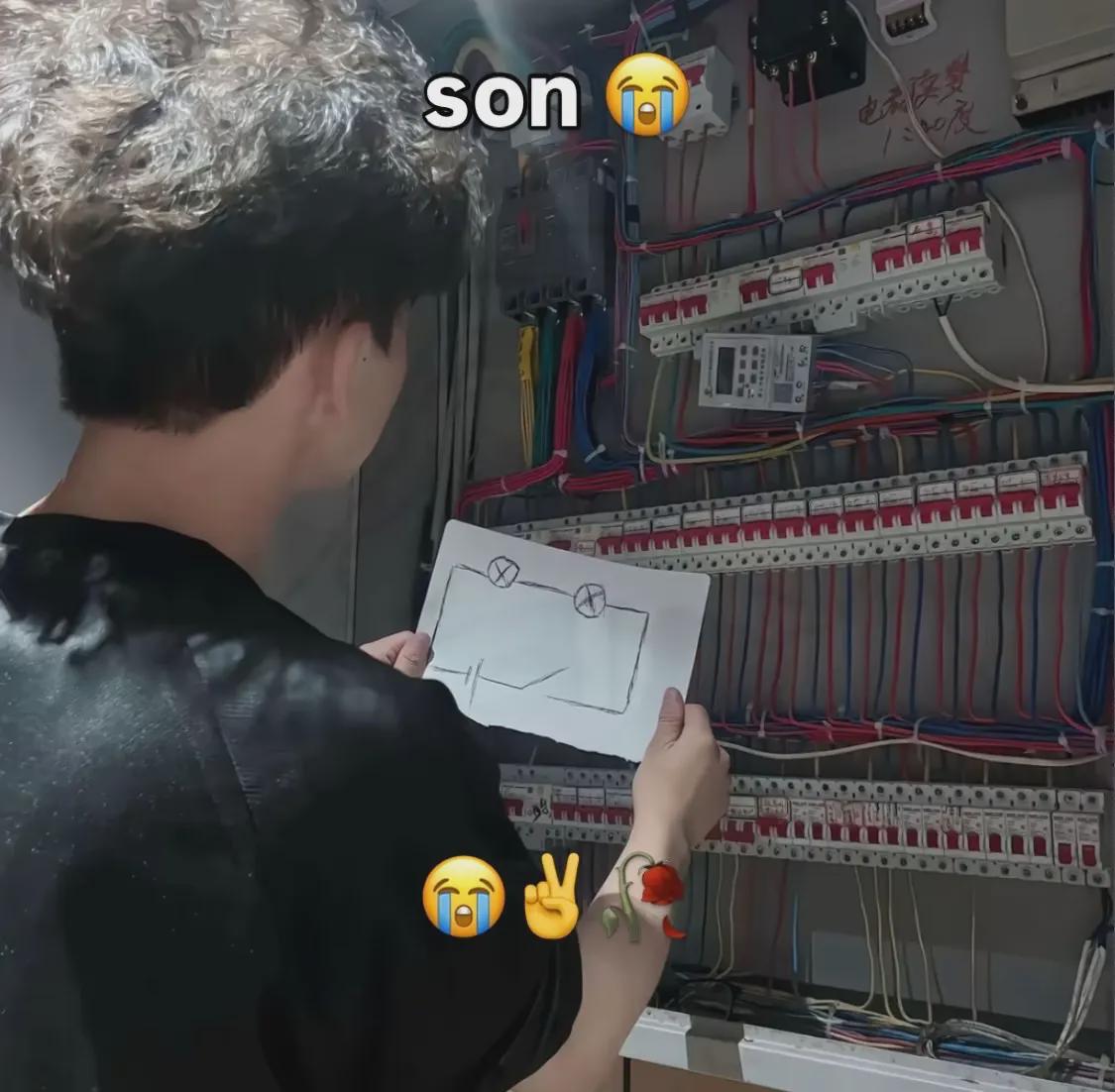
Every engineering student has experienced this exact moment of betrayal. You draw a simple circuit diagram with two lightbulbs and a battery—looks clean, straightforward, maybe takes 30 seconds to sketch. Then you walk into the electrical panel and it's like someone threw a rainbow of wires into a blender and hit "chaos mode." That innocent little loop on paper has somehow transformed into a labyrinth of circuit breakers, terminal blocks, and enough color-coded wiring to make you question your career choices. The "son 😭" caption perfectly captures that moment when theory meets reality and reality wins by knockout. Those four years? That's not just your degree—that's how long it'll take to trace where that one red wire actually goes. The real kicker is that both circuits technically do the same thing. But one exists in the beautiful, simplified world of textbooks, while the other lives in the harsh reality of safety codes, wire management, and the fact that electricity doesn't care about your neat diagram.
 Academia
 Ai
 Astronomy
 Biology
 Chemistry
 Climate
 Conspiracy
 Earth-science
 Engineering
 Evolution
 Geology