Multiples Memes

Posts tagged with Multiples

Multiples Of 3

Multiples Of 3
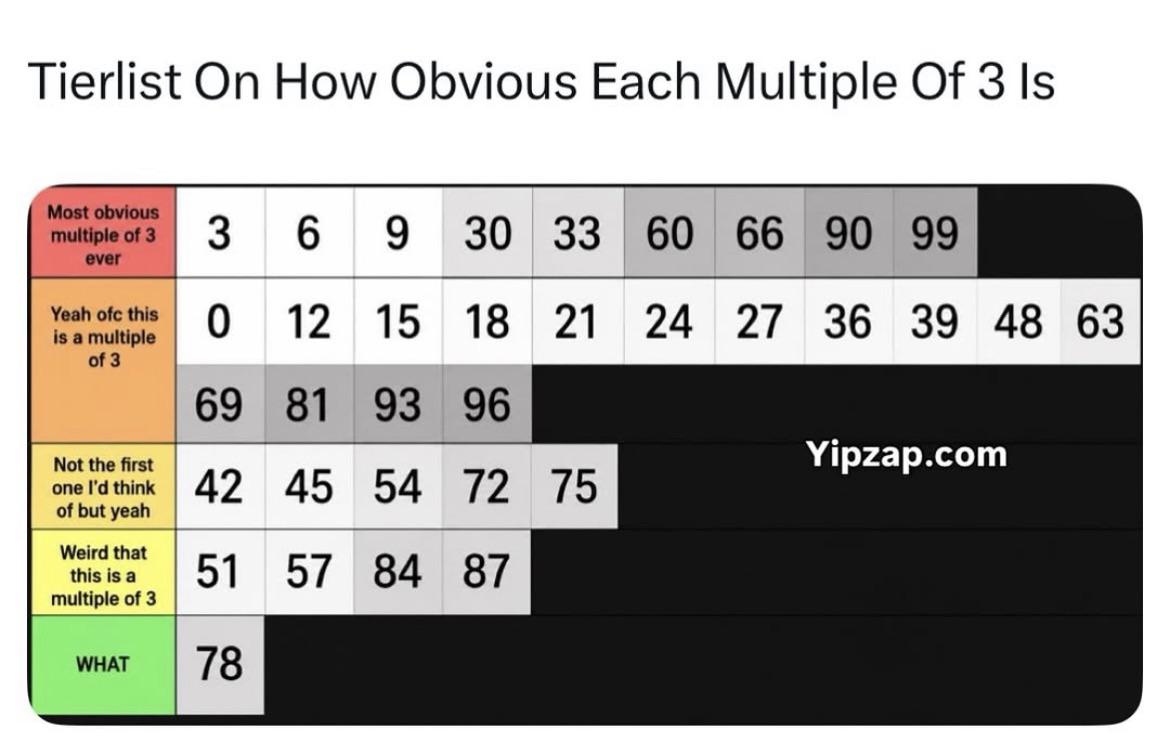
This tier list ranks multiples of 3 by how immediately recognizable they are as divisible by 3. At the top, we've got the heavy hitters like 3, 6, and 9—numbers so obviously divisible by 3 that even your sleep-deprived brain at 3 AM could confirm it. Then there's the "yeah okay" tier with numbers like 12, 15, and 21 where you nod along confidently. But then things get spicy. Numbers like 42 and 54 make you pause for a second—you know they're multiples of 3, but you need that mental confirmation. The "weird that this is a multiple of 3" tier features rebels like 51 and 87, which just feel wrong somehow, like they snuck into the club with a fake ID. And finally, there's 78 in the "WHAT" category. Mathematically, 78 = 26 × 3, but emotionally? It refuses to cooperate with our pattern-seeking brains. The number just radiates chaotic energy, like it's divisible by 3 purely out of spite. Pro tip: A number is divisible by 3 if the sum of its digits is divisible by 3. For 78: 7 + 8 = 15, and 15 ÷ 3 = 5. Science (well, math) doesn't lie, even when your intuition screams otherwise.

The Forbidden Mathematical Handshake

The Forbidden Mathematical Handshake
The ultimate mathematical friendship! Two number types that should NEVER get along - primes (those snooty numbers divisible only by 1 and themselves) and multiples of 3 (the party animals of math) - finding common ground in the number 57! Plot twist: 57 is neither prime NOR a multiple of 3! It's 3×19, so it IS a multiple of 3, but definitely not prime. This is like watching two enemies bond over something that only one of them actually relates to! Mathematical miscommunication at its finest! 🤓

Where's My Unsee Juice? Mathematical Villain Edition

Where's My Unsee Juice? Mathematical Villain Edition
The villain just dropped the most mind-blowing mathematical truth bomb and casually walked away! 🤯 It's true - prime numbers (except 2 and 3) are always exactly one away from multiples of 6. Think about it: 5 is next to 6, 7 is next to 6, 11 is next to 12, 13 is next to 12... The pattern continues forever! This is because any number can be written as 6k, 6k+1, 6k+2, 6k+3, 6k+4, or 6k+5, but 6k, 6k+2, 6k+3, and 6k+4 are always divisible by something, leaving only 6k+1 and 6k+5 as potential primes. Math nerds everywhere are simultaneously impressed and horrified that this villain just revealed one of number theory's elegant secrets before disappearing into the darkness!