
Logic Memes

Posts tagged with Logic
Tier List Of Proof Methods

Tier List Of Proof Methods
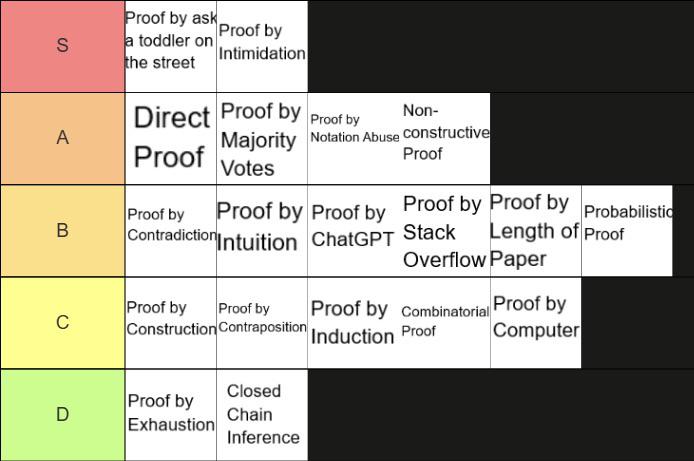
Mathematicians ranking their proof techniques like they're competitive Smash Bros characters, and honestly? The chaos is *chef's kiss*. S-tier naturally includes "Proof by asking a toddler on the street" and "Proof by intimidation" because nothing says mathematical rigor like scaring your theorem into submission or consulting a three-year-old's unfiltered wisdom. Meanwhile, "Direct Proof" is chilling in A-tier like it's not literally the foundation of mathematics—apparently being straightforward is overrated. B-tier is where the modern era shines: "Proof by ChatGPT" sitting comfortably next to "Proof by Stack Overflow" because why do the work yourself when the internet hivemind exists? "Proof by Intuition" is there too, which is just fancy talk for "trust me bro, it feels right." Down in D-tier we've got "Proof by Exhaustion" and "Closed Chain Inference"—the methods so tedious that even mathematicians are like "yeah, it works, but at what cost?" Your wrist hurts, your soul is drained, but hey, QED. The real crime? "Proof by Induction" languishing in C-tier when it's literally carrying half of discrete mathematics on its back. Put some respect on the domino effect's name!

Teenagers Vs. Basic Algebra

Teenagers Vs. Basic Algebra
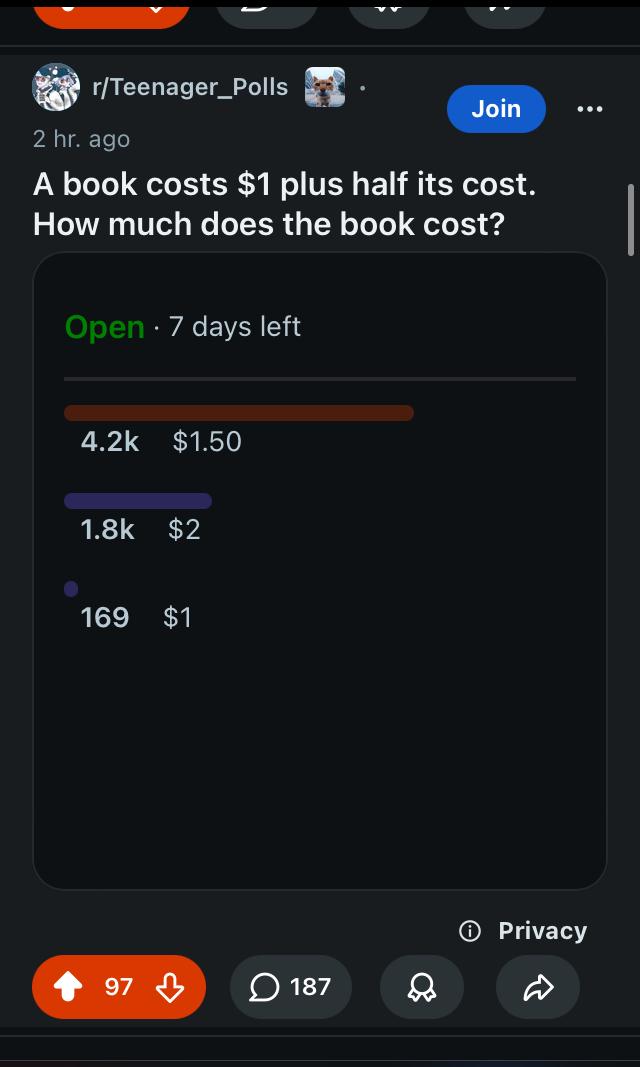
Let's set up the equation: x = $1 + 0.5x. Subtract 0.5x from both sides, get 0.5x = $1, therefore x = $2. It's literally one of the simplest algebra problems you can give someone. But here's where it gets beautiful: 4,200 teenagers confidently voted for $1.50, which would mean the book costs $1.50 and half its cost is $0.75, giving us a total of... $2.25. Not $1.50. The math isn't mathing, folks. The 1,800 people who voted $2 are sitting there like "did everyone else skip 7th grade?" Meanwhile, 169 brave souls chose $1, presumably thinking the book just costs itself plus... nothing? The confidence-to-correctness ratio in online polls never fails to deliver existential dread about our collective future.

Is This Even About Science Or Just About The Meaning Of Relative Terms?

Is This Even About Science Or Just About The Meaning Of Relative Terms?
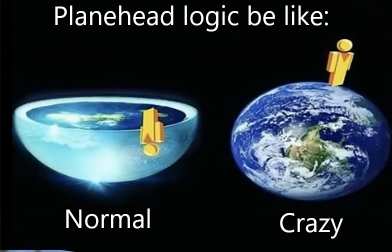
Flat-earthers really out here calling everyone else crazy while believing we live on a cosmic dinner plate with a firmament dome. The irony is chef's kiss level. Standing on a flat disc: "Yeah, this makes sense." Standing on a sphere that's been photographed from space thousands of times: "You're insane." The mental gymnastics required to flip these labels is honestly more impressive than the conspiracy itself. It's like calling someone paranoid while wearing a tinfoil hat.

I Love Proving Numbers Exist

I Love Proving Numbers Exist
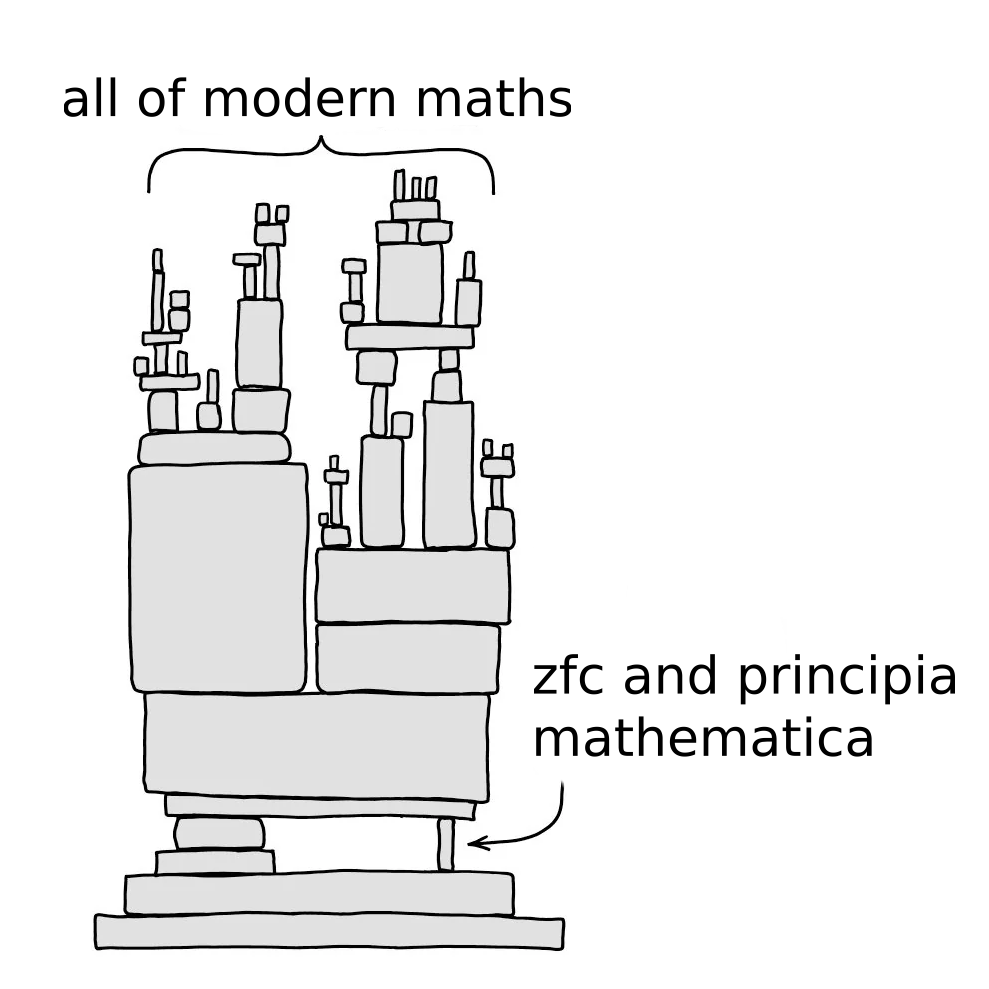
You know you're deep in the mathematical weeds when your entire field rests on two tiny axioms at the bottom. ZFC (Zermelo-Fraenkel set theory with the Axiom of Choice) and Principia Mathematica are basically the "trust me bro" foundation that holds up literally everything else in modern mathematics. It's like building a skyscraper on a couple of pebbles and hoping nobody asks too many questions about whether those pebbles are actually real. Mathematicians spent centuries just trying to prove that numbers exist and that 1+1=2 without creating logical paradoxes. Bertrand Russell and Alfred North Whitehead needed over 300 pages in Principia Mathematica to rigorously prove that 2+2=4. Meanwhile, the rest of us are up there doing calculus, topology, and abstract algebra, blissfully unaware that the entire enterprise could theoretically collapse if someone finds a contradiction in the axioms. The best part? We can't even prove these foundational systems are consistent from within themselves (thanks, Gödel). So yeah, modern math is just vibes built on unproven assumptions. Sleep tight!

A Problem Is Called Closed If Its Negation Is Open

A Problem Is Called Closed If Its Negation Is Open
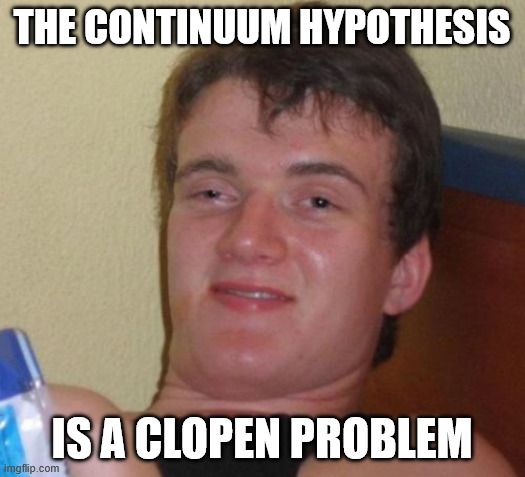
Someone just discovered topology and their brain is doing backflips. The "10 guy" meme format perfectly captures that glazed-over look you get when you realize the continuum hypothesis—one of the most mind-bending unsolved problems in set theory—is literally both "closed" and "open" depending on how you look at it. In topology, a set is "closed" if its complement is "open" (and vice versa). So naturally, our stoned mathematician here has coined the term "clopen" for sets that are BOTH closed AND open simultaneously. And guess what? The continuum hypothesis, which deals with whether there's a set size between countable infinity and the continuum, is independent of standard axioms—meaning you can neither prove nor disprove it. It's mathematically... clopen. The beauty here is watching someone's neurons fire in real-time as abstract mathematics collides with wordplay. In ZFC set theory, the continuum hypothesis is neither provably true nor false, making it the ultimate "clopen problem." It's like Schrödinger's mathematical statement, except instead of a cat, it's Cantor's infinities having an existential crisis.

Naming Your Child After Math Theorems

Naming Your Child After Math Theorems
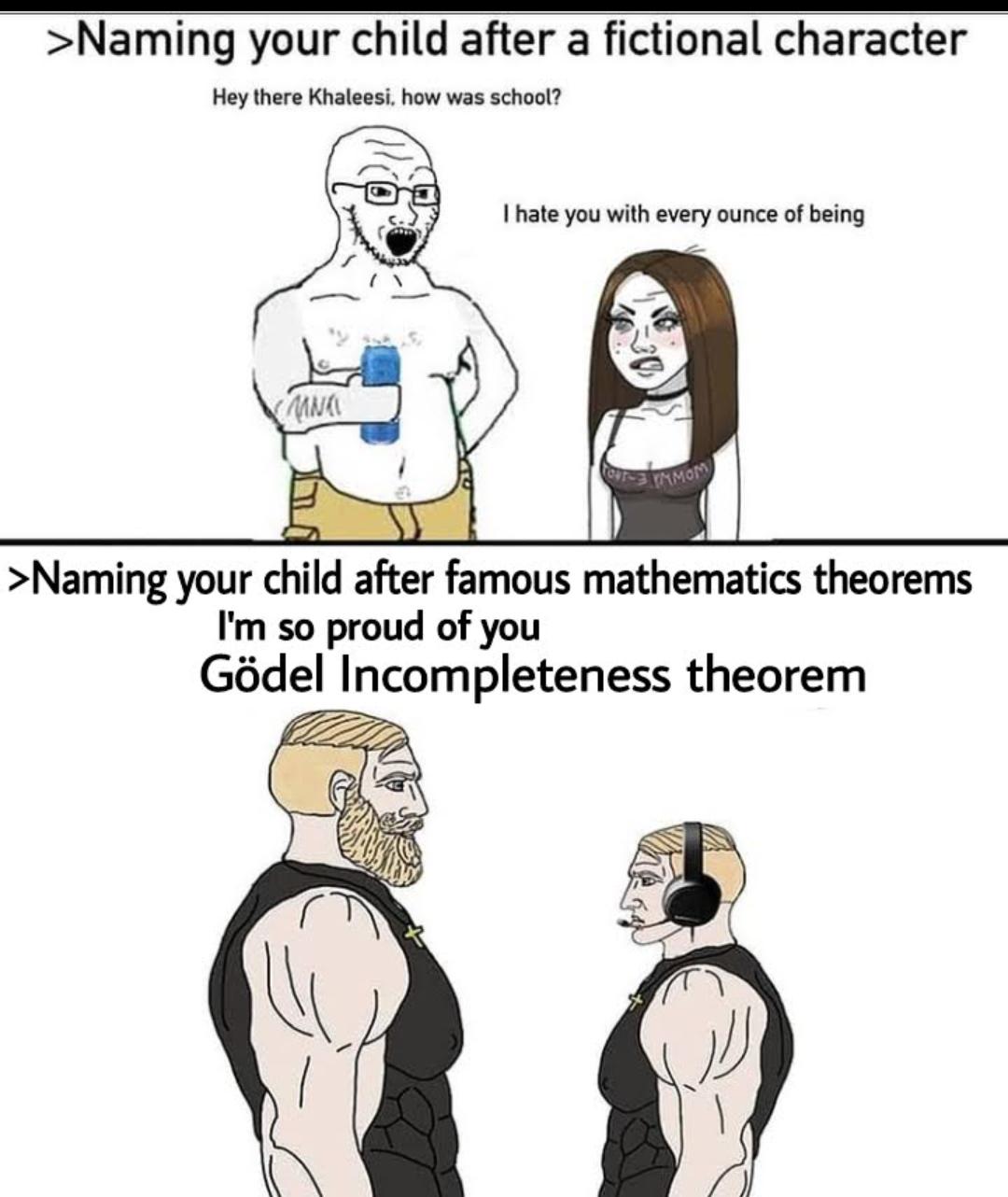
Imagine ruining your kid's social life before they even learn to walk. Naming your child "Khaleesi" is one thing—at least Game of Thrones was popular for a hot minute. But naming them after Gödel's Incompleteness Theorem? That's next-level dedication to mathematics. For those blissfully unaware, Gödel's Incompleteness Theorems basically proved that in any mathematical system complex enough to do basic arithmetic, there will always be true statements that can't be proven within that system. It's the mathematical equivalent of "some questions don't have answers," which ironically is what little Gödel will be saying when people ask about their name at parties. The real kicker? The parent is PROUD. Meanwhile, their child will spend their entire school career explaining to teachers how to spell their name and why yes, their parents are indeed mathematicians who thought this was a brilliant idea. At least they'll never have to share their name with three other kids in class.

Use The Gamma Function, Use The Symmetry Of The Binomial Coefficient, Use The Taylor Sum, But Please, For The Love Of Euler, Don't Use This Argument For Why 0! = 1

Use The Gamma Function, Use The Symmetry Of The Binomial Coefficient, Use The Taylor Sum, But Please, For The Love Of Euler, Don't Use This Argument For Why 0! = 1
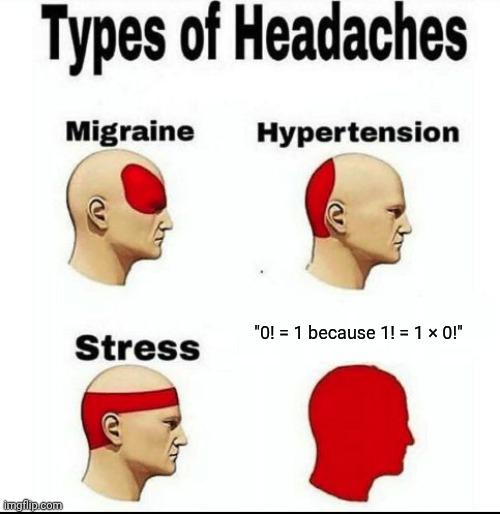
Mathematicians have legitimate, beautiful reasons for why 0! equals 1—the gamma function extension, combinatorial interpretations, the empty product convention—but then someone walks into your office and says "well obviously 0! = 1 because 1! = 1 × 0!" and you can literally feel your brain melting out of your ears. This circular reasoning is the mathematical equivalent of saying "I'm right because I said so." It's like proving water is wet by saying wet things are watery. The argument assumes what it's trying to prove, which is why it causes a full-body headache that makes migraines look like a gentle massage. Fun fact: The real reason 0! = 1 is that there's exactly ONE way to arrange zero objects—by doing nothing. It's the empty arrangement, and it counts. Much more elegant than this recursive nightmare that haunts every math professor's dreams.

But It's The Largest Number Why Are We Adding 1 Again

But It's The Largest Number Why Are We Adding 1 Again
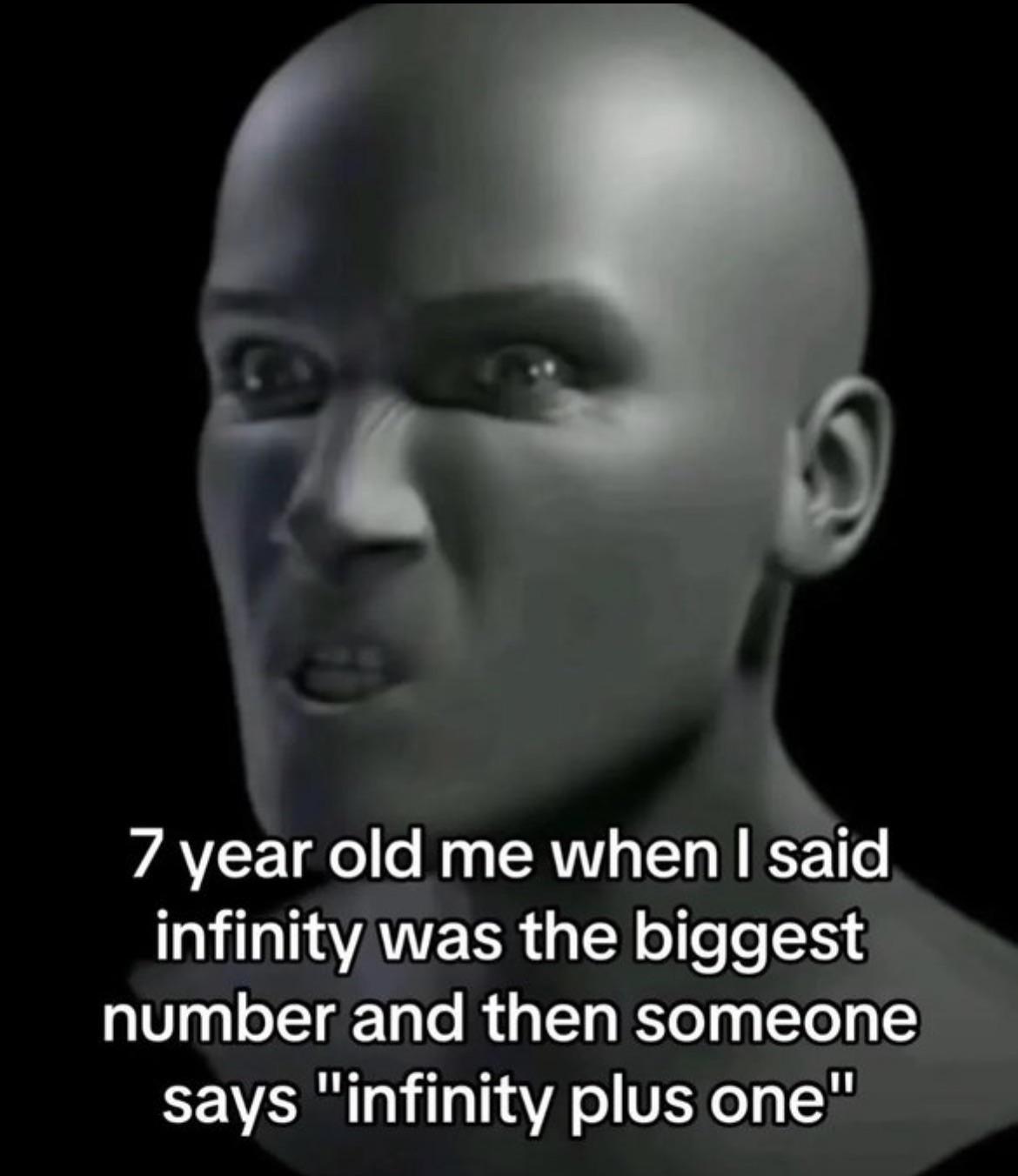
Welcome to the exact moment childhood innocence meets mathematical existential dread. You confidently declare infinity as the ultimate number, the final boss of counting, only to have some smartass introduce you to "infinity plus one" like they just invented fire. Here's the thing that broke your seven-year-old brain: infinity isn't actually a number—it's a concept representing something without bound. So saying "infinity plus one" is mathematically meaningless, like saying "wet plus one" or "Tuesday plus seven." But try explaining that to a kid in the middle of a playground argument about who has more of something. Mathematicians dealt with this by creating different "sizes" of infinity (thanks, Cantor), which somehow makes it worse. Turns out some infinities ARE bigger than others, so that annoying kid wasn't entirely wrong. The universe really said "you thought you understood big numbers?" and laughed in cardinality.

True, False And Can't Talk About It Bro

True, False And Can't Talk About It Bro
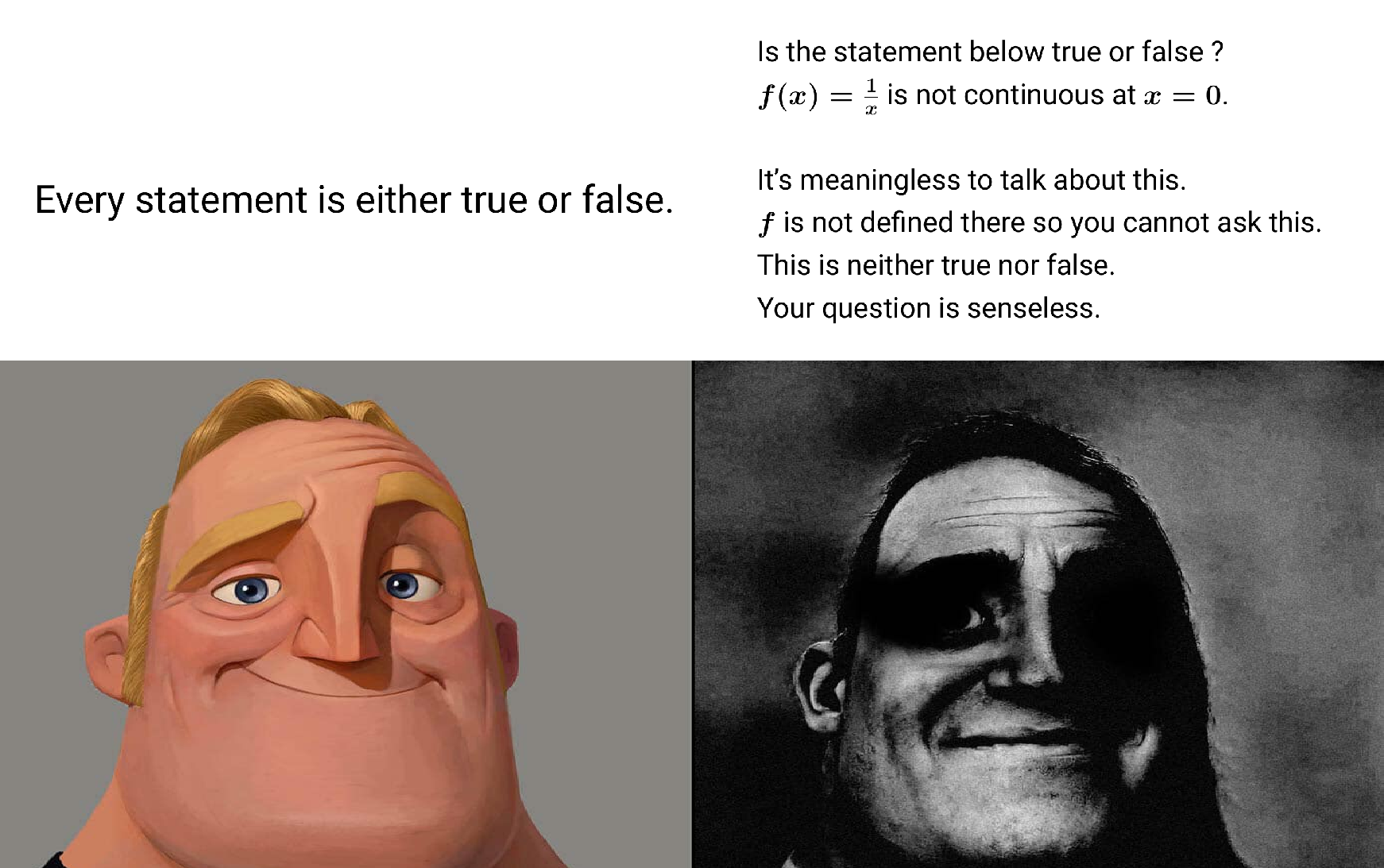
You know that smug feeling when you think you've got logic all figured out? Yeah, calculus just entered the chat to humble you. The function f(x) = 1/x literally doesn't exist at x = 0 because dividing by zero is the mathematical equivalent of asking "what color is Tuesday?" The question itself is broken! So when someone asks if the statement "f(x) is not continuous at x = 0" is true or false, mathematicians are like "bruh, the function isn't even DEFINED there, so we can't discuss its continuity." It's like asking if your imaginary friend is tall or short. The premise is flawed from the start! That's why this perfectly captures the third option beyond true/false: "this question is nonsense and we need to have a serious conversation about domain restrictions." Mathematics really said "not every question deserves an answer" and I respect that energy.

A Brilliant Construction Of The Reals With Set Builder Notation

A Brilliant Construction Of The Reals With Set Builder Notation
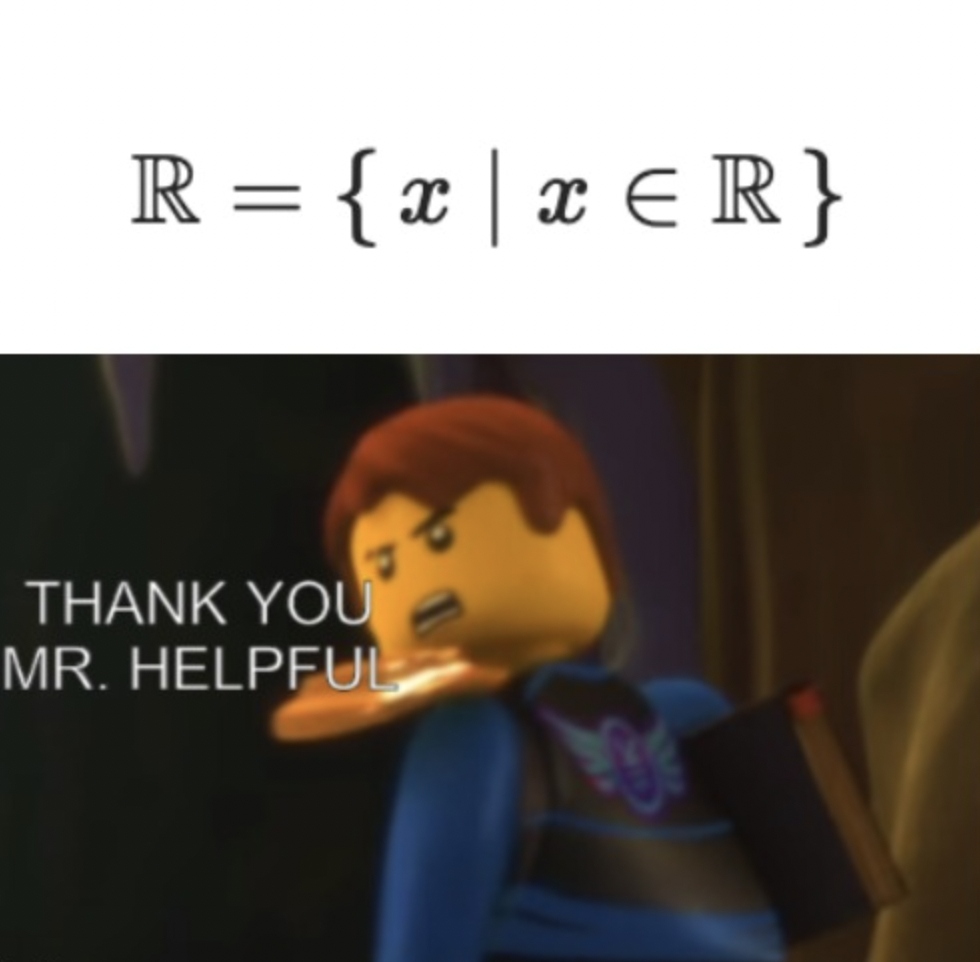
This is the mathematical equivalent of saying "the floor here is made of floor." The equation literally states that the real numbers (ℝ) are defined as the set of all x such that x is a real number. It's beautifully, hilariously circular! Set builder notation is supposed to construct or define sets using properties, but this definition just... assumes you already know what real numbers are. It's like defining a cat as "an animal that is a cat" – technically true, but spectacularly unhelpful. Mathematicians actually construct the reals through rigorous methods like Dedekind cuts or Cauchy sequences, so this lazy circular definition gets the sarcastic "thank you Mr. Helpful" treatment it deserves. Perfect example of when formalism meets maximum laziness.

Wtf Is Wrong With Hannah?

Wtf Is Wrong With Hannah?
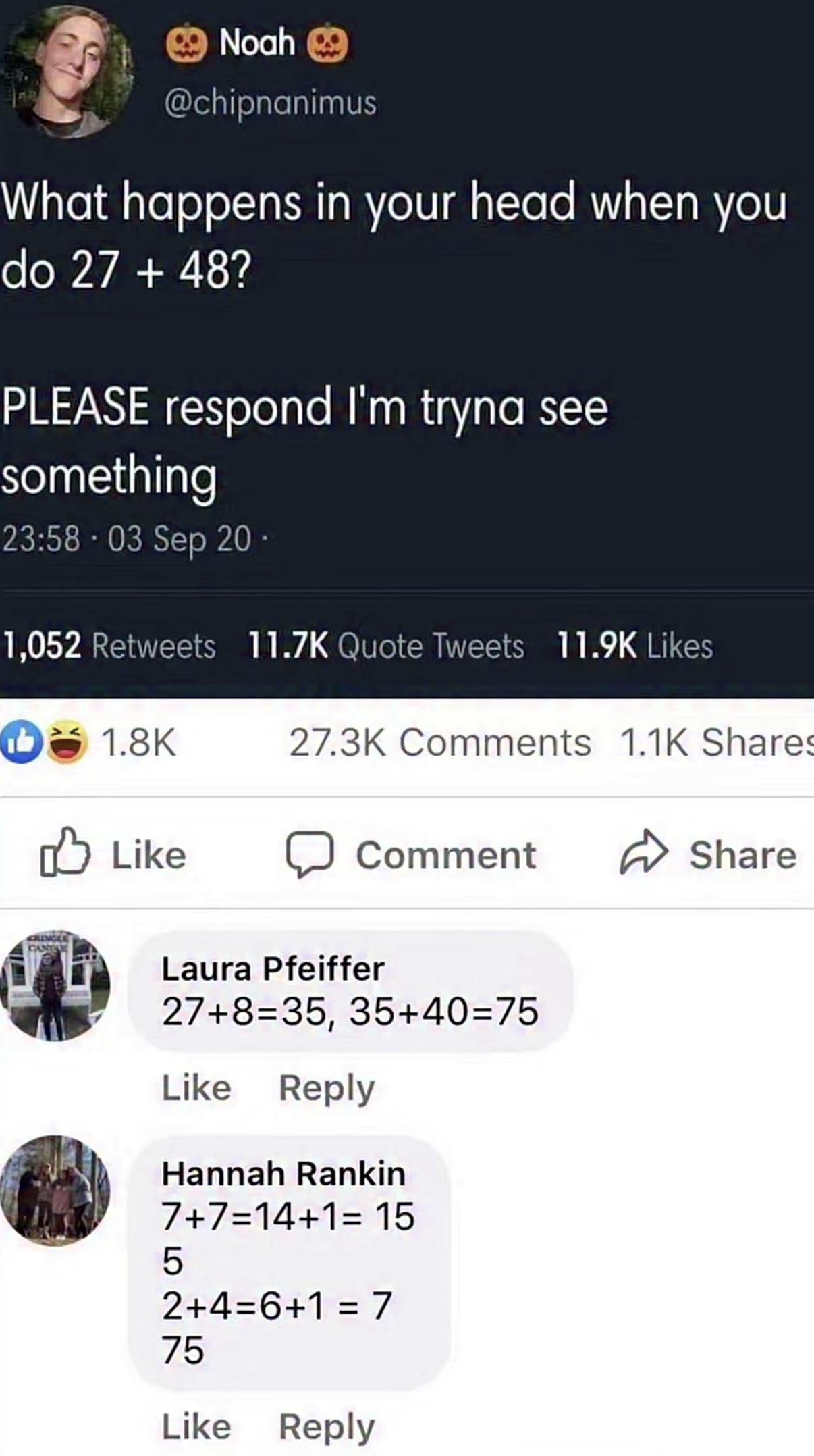
When someone asks what happens in your head when you do 27 + 48, there are exactly two types of people: Laura, who calmly breaks it down as 27+8=35, then 35+40=75, and Hannah, who apparently took the scenic route through mathematical chaos. Hannah's brain said "let's make this INTERESTING" and proceeded to do 7+7=14+1=15... wait, where did that 1 come from? Then somehow 5 appears out of nowhere, followed by 2+4=6+1=7, and miraculously lands on 75. It's like watching someone navigate with a broken GPS but still arriving at the correct destination. The mathematical equivalent of "task failed successfully." The best part? Both methods get you to 75, but Hannah's brain apparently needed to take every possible detour, pick up some random numbers along the way, and create what can only be described as arithmetic parkour. This is what happens when your mental math decides to speedrun through every possible combination of digits like it's trying to crack a safe.

"A Fire Breathing Dragon Lives In My Garage" - Carl Sagan

"A Fire Breathing Dragon Lives In My Garage" - Carl Sagan
Carl Sagan's famous thought experiment about the unfalsifiable dragon strikes again! The meme brilliantly captures his point about unfalsifiable claims—when someone says there's an invisible, incorporeal, floating dragon that spits heatless fire in their garage, it's functionally identical to having no dragon at all. Every time you try to test it, they add another qualifier that makes it impossible to verify. Sagan used this parable in "The Demon-Haunted World" to illustrate how claims that can't be tested or disproven are scientifically meaningless. If your hypothesis conveniently dodges every possible test—thermal cameras won't work because the fire is heatless, flour on the floor won't show footprints because it floats, etc.—then what's the difference between that and it not existing? The burden of proof lies with the claimant, and extraordinary claims require extraordinary evidence, not extraordinary excuses. The "Corporate needs you to find the differences" format is *chef's kiss* here because it perfectly mirrors the logical conclusion: they're the same picture because functionally, they ARE the same thing. Falsifiability is a cornerstone of the scientific method, and Sagan was a master at explaining why it matters.