
Light Memes

Posts tagged with Light
Iron Beam Laser Defense System Meme

Iron Beam Laser Defense System Meme
So you've got billions of dollars worth of cutting-edge military laser technology designed to vaporize incoming missiles at the speed of light... and then there's a compact mirror. Just a regular ol' reflective surface doing what it does best: bouncing photons like it's playing ping-pong with physics. The joke here is that lasers—no matter how sophisticated—are still just concentrated light beams. And what do mirrors do? They reflect light. So theoretically, a simple mirror could deflect a laser attack by sending all that concentrated energy right back where it came from. It's like bringing a $2 pocket mirror to a billion-dollar laser fight and actually having a chance! Of course, in reality, military-grade lasers would probably melt most mirrors before you could say "angle of incidence equals angle of reflection," but the absurdity of a tiny compact mirror being the theoretical nemesis of advanced weaponry is *chef's kiss* comedy gold.

Rayleigh Scattering

Rayleigh Scattering
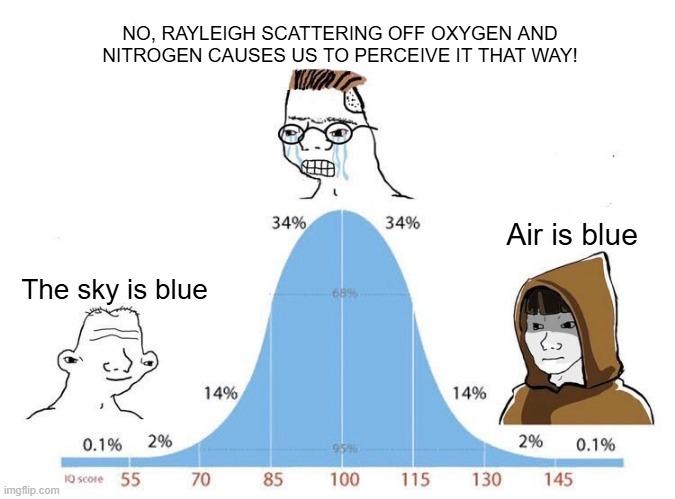
This bell curve perfectly captures the intellectual journey of understanding why things are blue. The casual observer sees the sky and goes "yep, blue sky." The person who just learned about Rayleigh scattering in their intro physics class becomes insufferable, ready to correct anyone who dares suggest the sky is simply blue without mentioning the wavelength-dependent scattering of sunlight by atmospheric molecules. Then you reach enlightenment and realize that air itself appears blue when you look at enough of it—mountains in the distance, thick atmosphere, same principle, less pretension. For context: Rayleigh scattering happens because shorter wavelengths (blue light) scatter more strongly than longer wavelengths (red light) when interacting with particles much smaller than the wavelength of light. So yes, oxygen and nitrogen molecules scatter blue light more, making the sky blue. But here's the kicker—if you stack enough air molecules together, like when looking at distant mountains or a thick layer of atmosphere, the cumulative effect makes the air itself look blue. Same physics, different framing, way less annoying at parties.

Guys, How Do I Tell This To My Bf?

Guys, How Do I Tell This To My Bf?
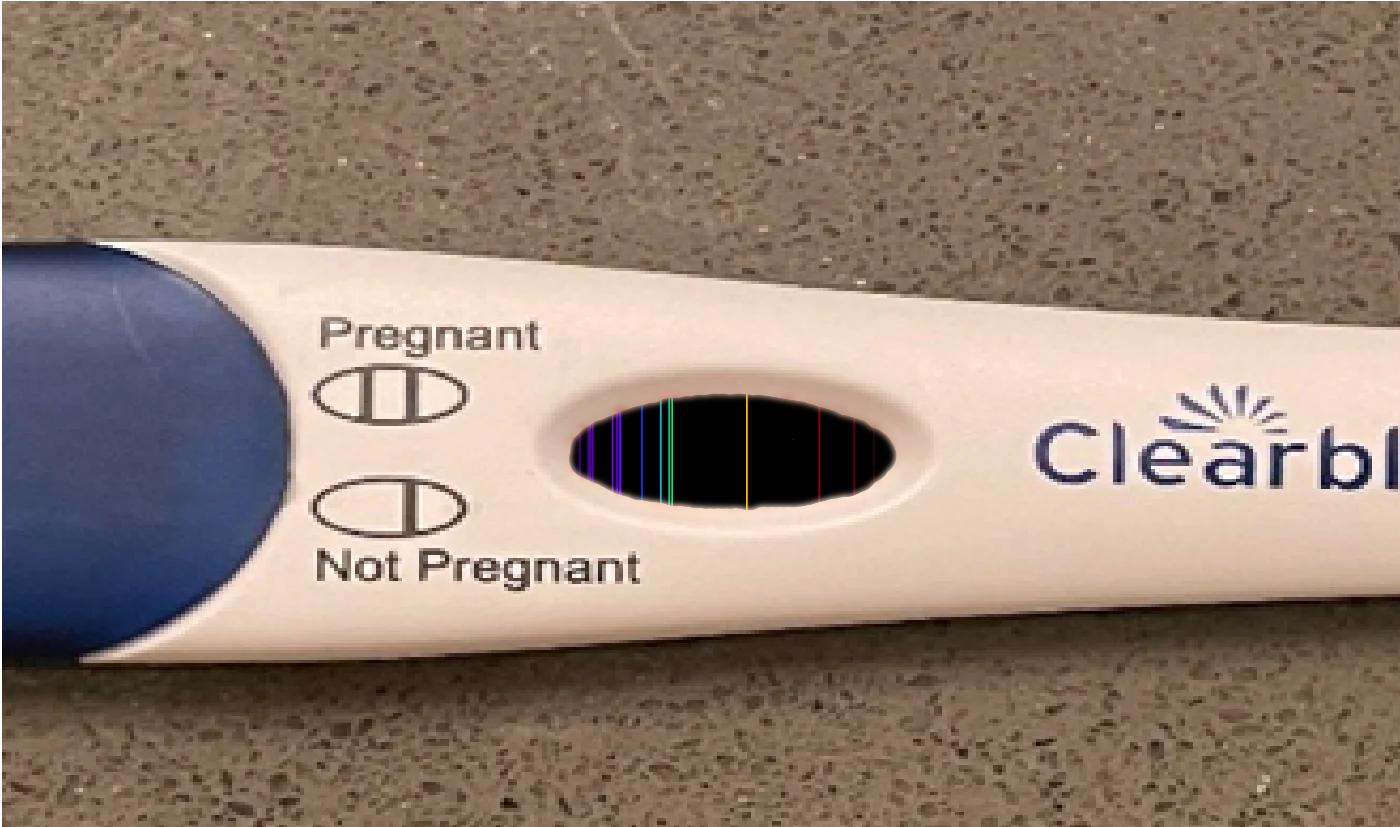
So apparently someone's pregnancy test just revealed the entire electromagnetic spectrum instead of a simple yes or no. That result window is showing a full spectroscopic readout with all those colorful vertical lines—like the test didn't just detect hCG hormones, it detected an entire rainbow baby. Literally. This is what happens when you accidentally use a spectrometer instead of a pregnancy test. The baby isn't just coming—it's coming with full wavelength data from ultraviolet to infrared. Congratulations, you're not just pregnant, you're pregnant with all frequencies of light simultaneously . The boyfriend is gonna need more than "we need to talk" for this one. Maybe start with "honey, our child is either a star or a diffraction grating." Fun fact: Those spectral lines are how scientists identify elements in distant stars. So either this test is broken, or you're about to give birth to a sentient nebula. Either way, stock up on diapers AND a telescope.

The Photoelectric Standoff

The Photoelectric Standoff
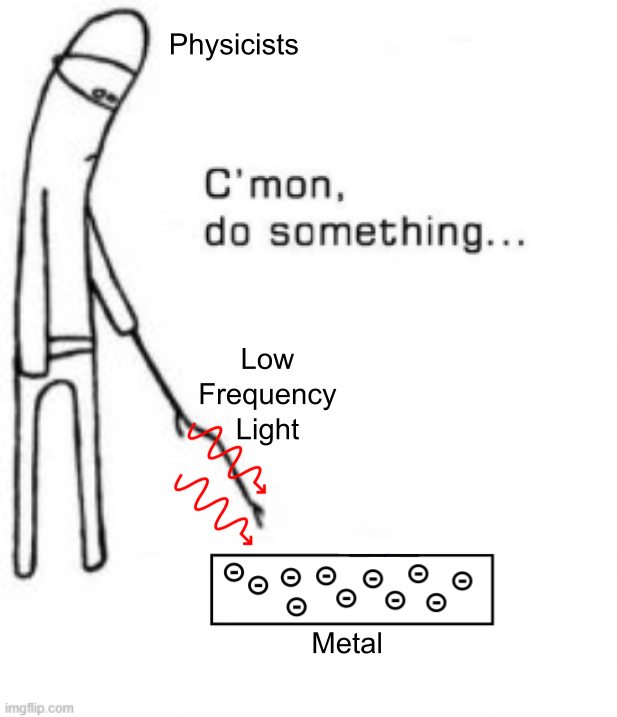
Ever watched a physicist desperately shine red light on metal and wonder why nothing's happening? That's the photoelectric effect trolling them hard. Low frequency light won't kick electrons out no matter how intense—like trying to make a basketball bounce by throwing ping-pong balls at it. Einstein figured this out in 1905, but some stubborn souls still think "MORE POWER" is the answer. Spoiler: those electrons aren't budging until you bring some proper high-frequency UV light to the party.

Only In A Vacuum

Only In A Vacuum
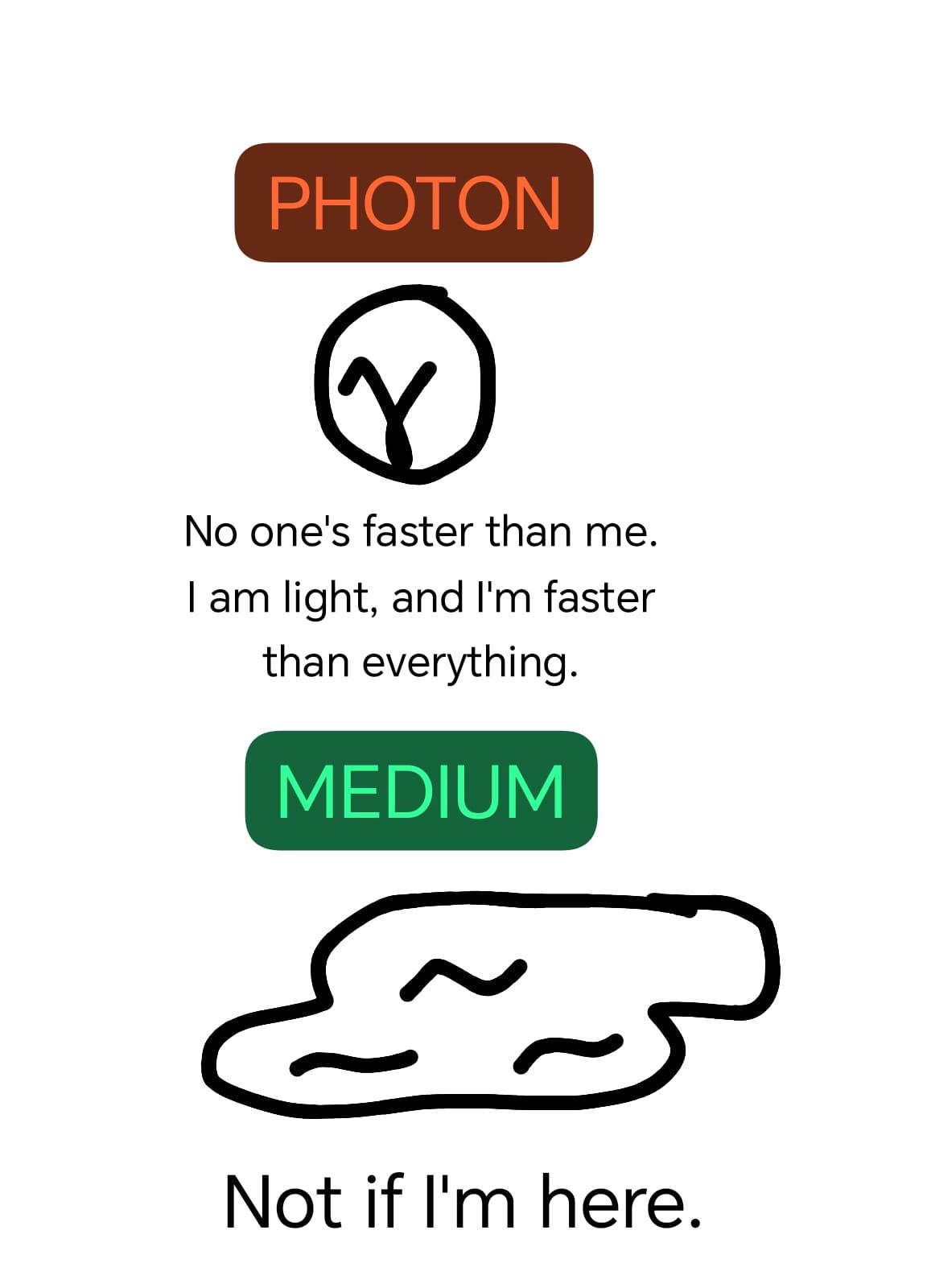
The speed of light isn't so absolute after all! This physics joke captures the fundamental truth that light travels at different speeds through different mediums. In a vacuum, photons zip along at their maximum speed (299,792,458 m/s) with nothing to slow them down. But introduce a medium like water, glass, or even air, and those photons get significantly delayed as they interact with atoms and molecules. It's like the difference between sprinting down an empty hallway versus trying to run through a crowded mall. The medium is literally throwing shade at the photon's speed-bragging rights!

And Physics Goes: "Let's Do It Twice"

And Physics Goes: "Let's Do It Twice"
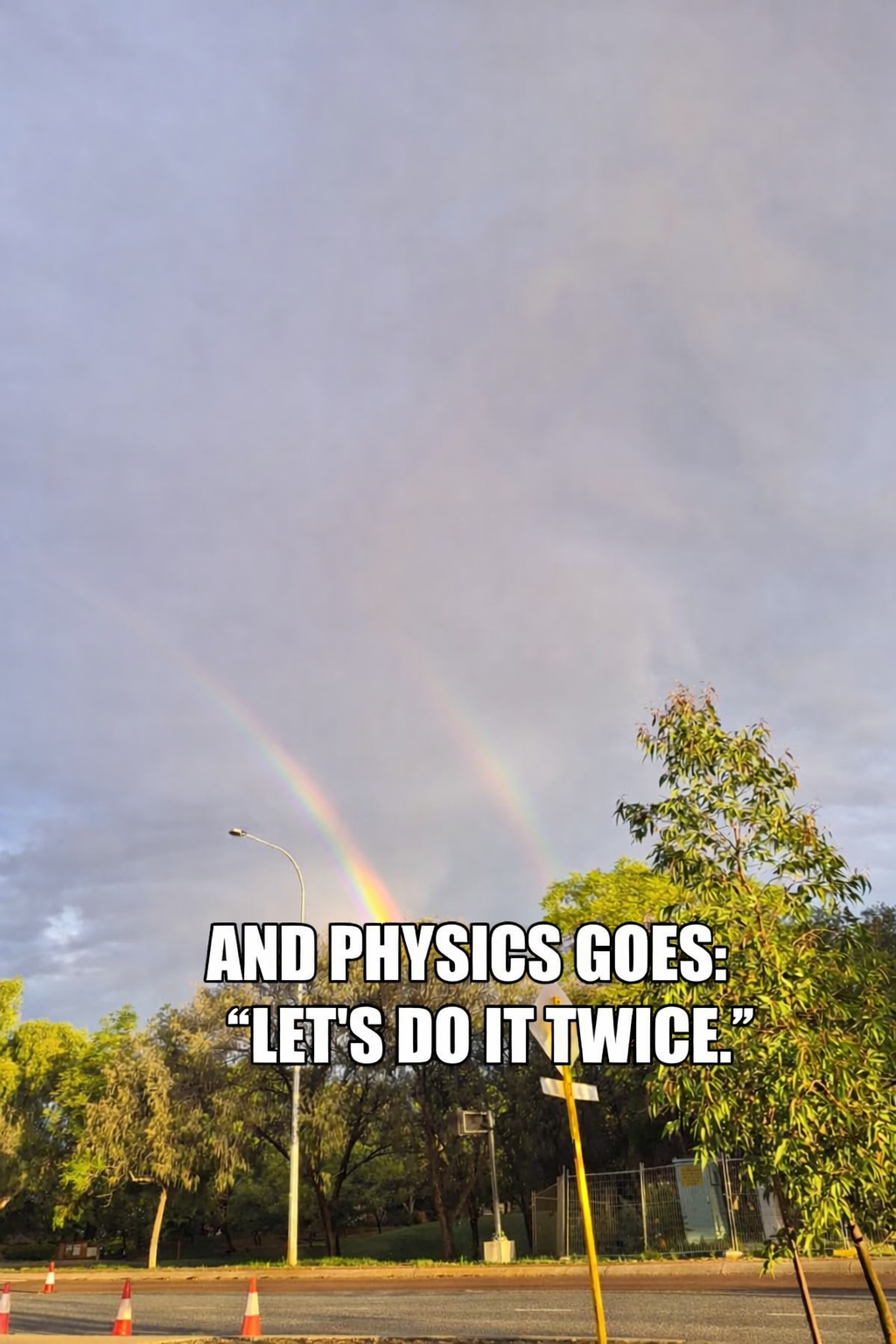
Double rainbow, double the refraction! The meme captures nature's optical flex - when light hits water droplets at just the right angle and physics decides one rainbow isn't impressive enough. The secondary rainbow appears because light reflects twice inside each raindrop instead of once, creating that fainter, color-reversed arc. It's basically light saying "watch me bounce around in these water droplets like I'm in a tiny aquatic pinball machine." Nature's way of showing off its physics degree!

Plankton's Perfect Photosynthetic Dinner

Plankton's Perfect Photosynthetic Dinner
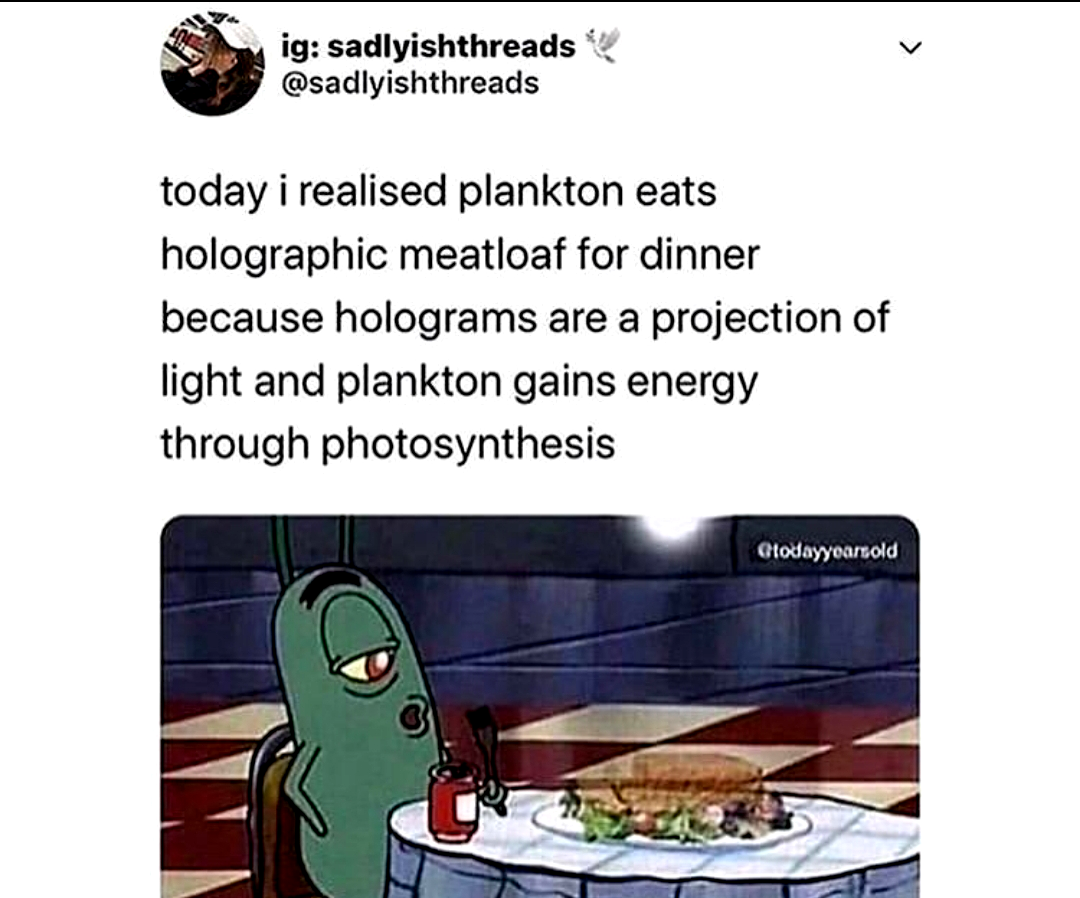
Mind = blown. Someone finally connected the dots between Plankton from SpongeBob and actual marine plankton biology! The character's diet would technically be light-based since phytoplankton convert sunlight to energy through photosynthesis. So a holographic meatloaf (pure light projection) is the perfect marine microorganism meal. It's like discovering your favorite cartoon has secretly been teaching accurate biology this whole time. Next revelation: maybe Squidward really does have the anatomical features of a cephalopod?

What Could Possibly Go Wrong?

What Could Possibly Go Wrong?
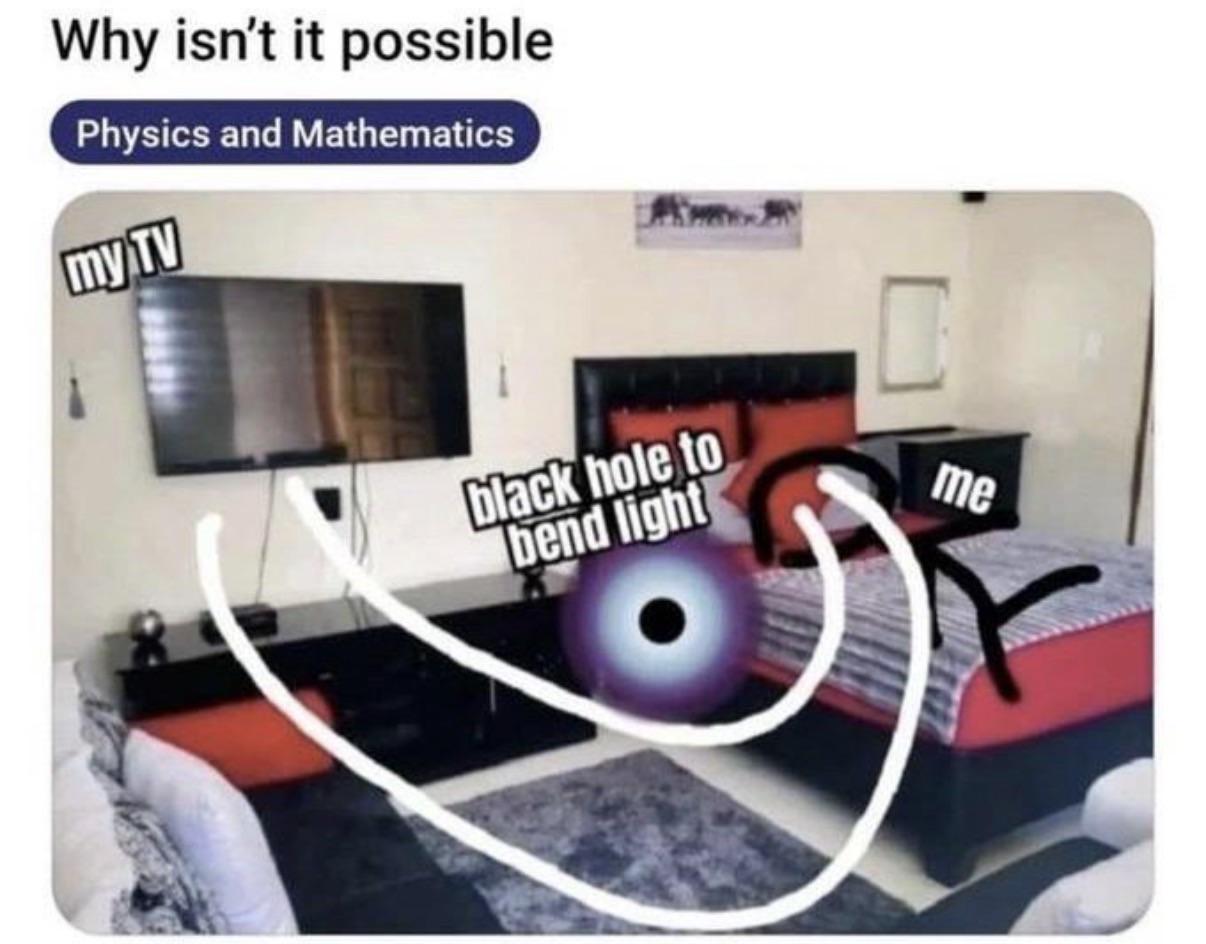
Just your average undergrad wondering why they can't watch TV from bed while a literal spacetime-warping singularity sits between them. Sure, kid! Just ignore that pesky gravitational field strong enough to trap light itself. Maybe try explaining to the black hole that you're only on season 3 of your favorite show? I'm sure it'll understand and politely redirect those photons your way instead of dragging them into the abyss of no return. Next brilliant idea: using a neutron star as a night light!

Sunrise And Sunsets: It's Complicated

Sunrise And Sunsets: It's Complicated
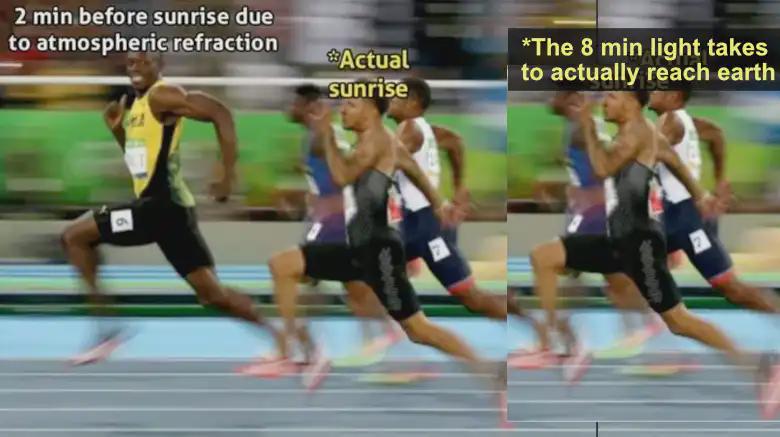
That moment when you realize the sun is playing mind games with us! What we call "sunrise" is actually a triple illusion. First, we see it 2 minutes before it's actually there thanks to atmospheric refraction bending light around our curved planet. Second, the "actual sunrise" happened 8 whole minutes ago because light takes its sweet time traveling from the sun. Third, the sun doesn't even "rise" - we're the ones spinning! The entire concept of sunrise is just our tiny human brains trying to make sense of cosmic mechanics while standing on a rotating space rock. Next time someone invites you to watch the sunrise, hit them with "which one?" and enjoy the confusion.

I Am Sorry Newton...

I Am Sorry Newton...
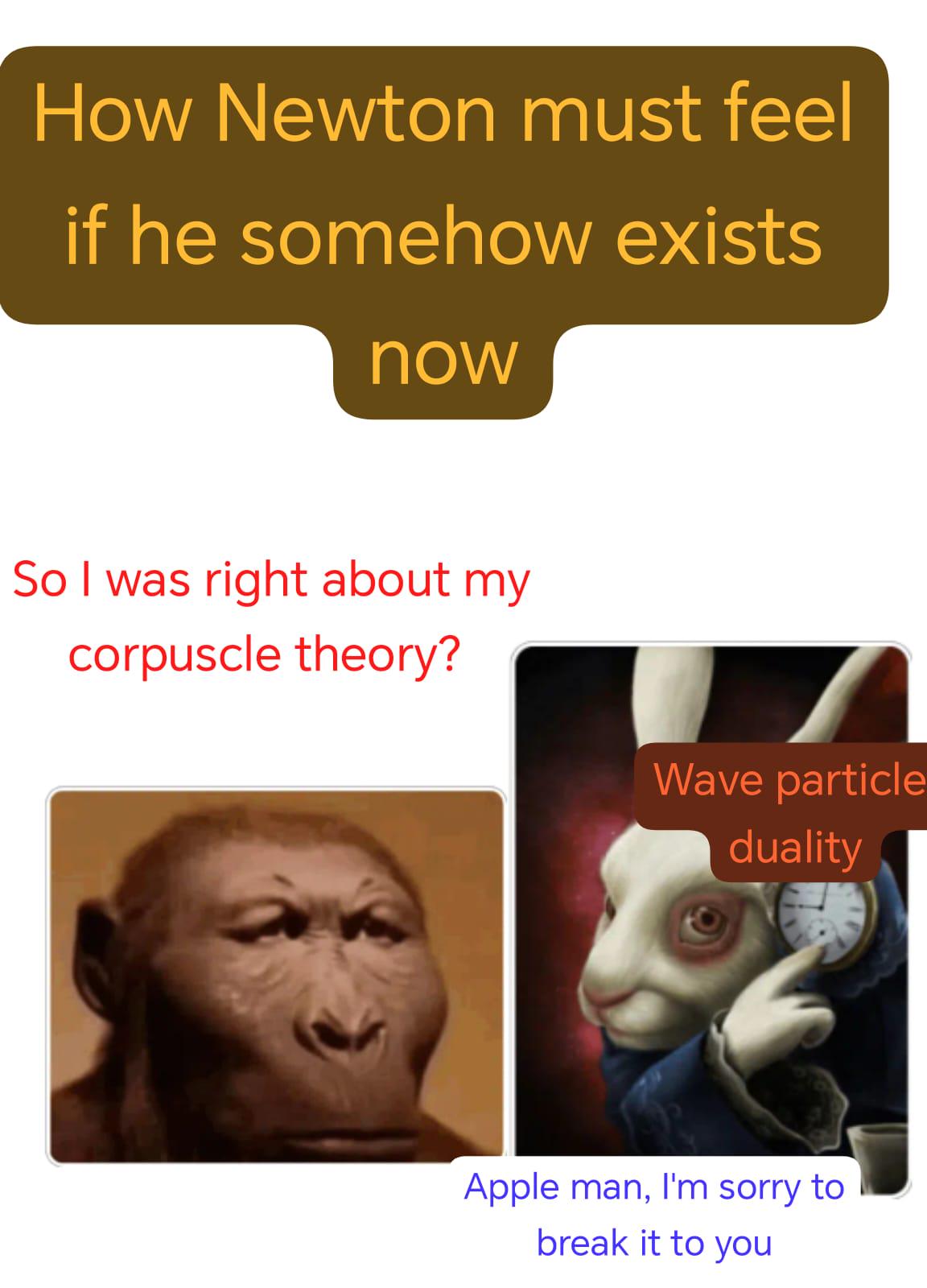
Newton's ghost just found out his corpuscular theory of light wasn't completely wrong after all! The meme brilliantly pits classical Newtonian physics against quantum mechanics, where light behaves as both a wave AND a particle. Poor Newton theorized light as tiny particles (corpuscles) in the 1600s, got overshadowed by wave theory for centuries, then quantum physics comes along with wave-particle duality and basically says "you were kinda right!" The White Rabbit from Alice in Wonderland breaking the news to "Apple Man" is pure scientific comedy gold. Newton's probably spinning in his grave fast enough to generate electricity right now.

The Darkness Projector

The Darkness Projector
The eternal quest for innovation strikes again! While we've mastered illuminating darkness with flashlights, some genius is contemplating the opposite—a device that projects darkness. Technically, this "reverse flashlight" would violate basic principles of light physics since darkness isn't a particle or wave you can emit—it's literally the absence of photons. But wouldn't it be delightfully chaotic to point this theoretical void-beam at someone and watch their confusion as a perfect circle of nothingness engulfs their face? The universe might object, but the pranking possibilities would be worth challenging the laws of physics.

The Test Isn't That Hard: Quantum Edition

The Test Isn't That Hard: Quantum Edition
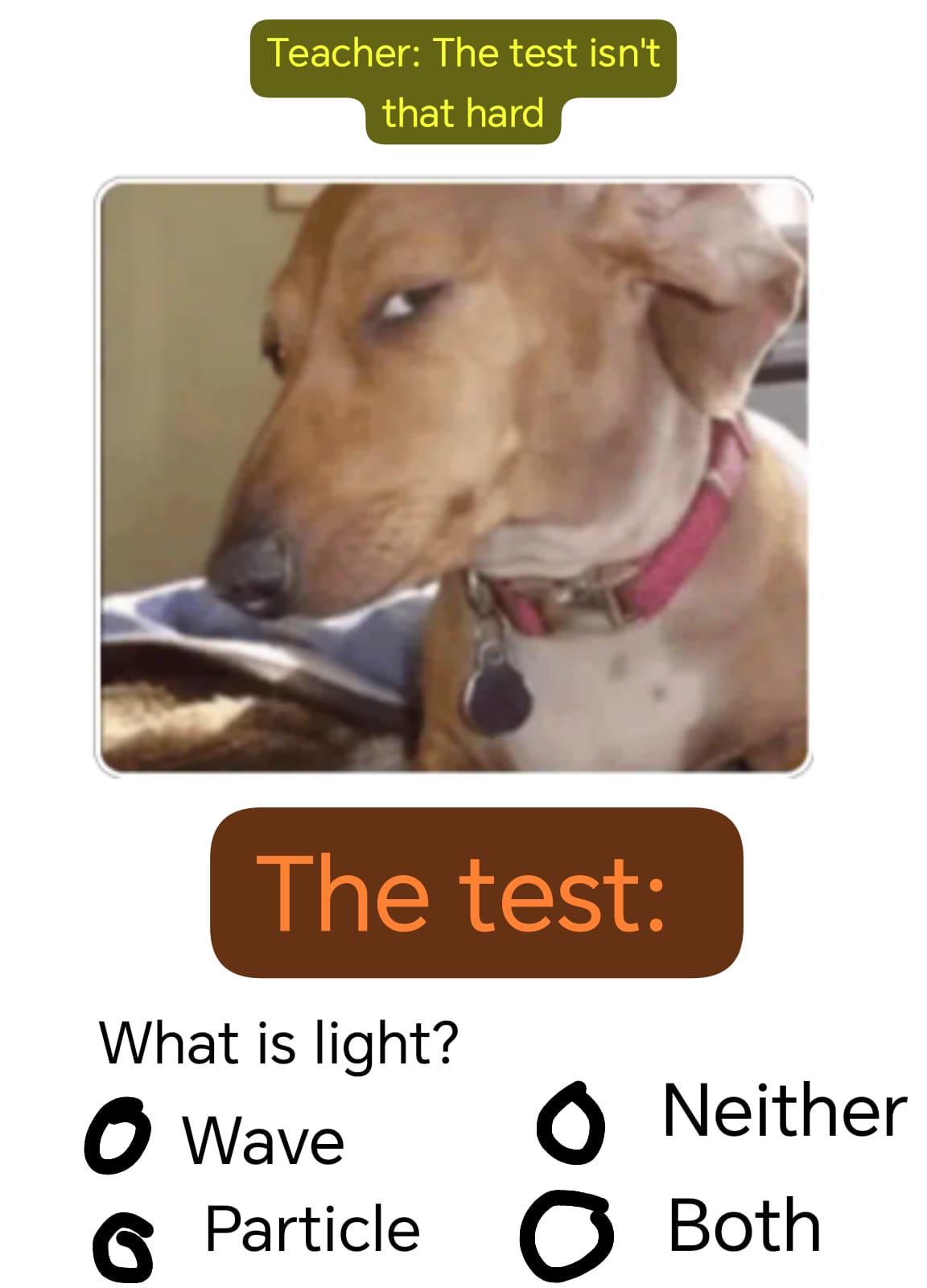
The infamous wave-particle duality question strikes again! That dog's existential dread perfectly captures the moment when you realize physics isn't just difficult—it's fundamentally unsettling. "What is light?" seems innocent until you discover the correct answer is "both" yet "neither" simultaneously. Just like Schrödinger's cat, your grade exists in a superposition of passing and failing until observed by your professor, who probably enjoys watching students squirm through this quantum nightmare. 30 years teaching this stuff and I still chuckle when freshmen confidently circle "wave" or "particle" like reality could ever be that straightforward!