

Combinatorics Memes

Posts tagged with Combinatorics
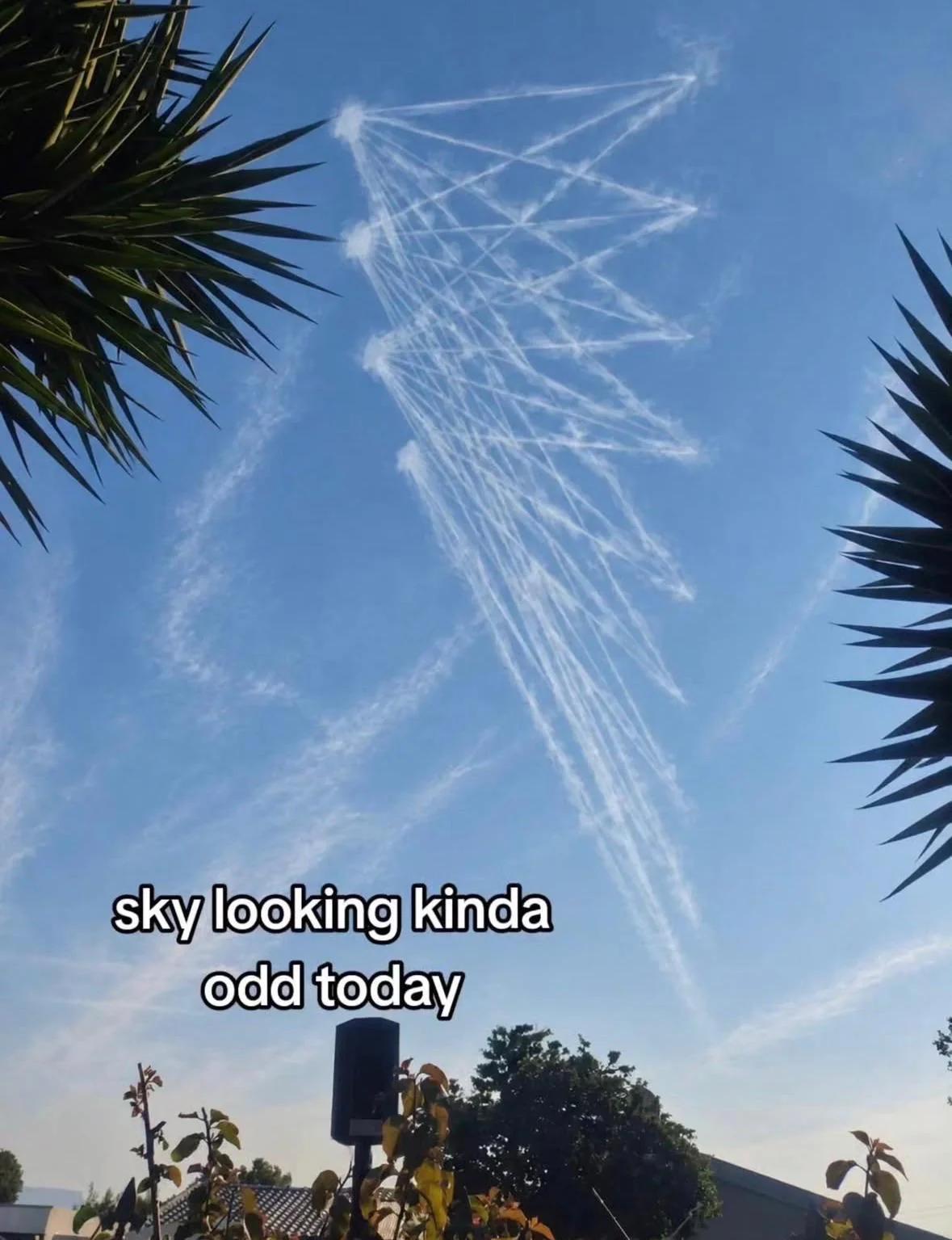
K{4,9} Be Like

K{4,9} Be Like
When mathematicians look up and see a complete bipartite graph drawn in the sky by contrails, you know it's either a sign from the math gods or pilots got REALLY bored up there. K{4,9} is graph theory notation for a complete bipartite graph with 4 vertices on one side and 9 on the other—meaning every vertex in one set connects to every vertex in the other set. That's 36 edges of pure mathematical chaos, and honestly, these contrails are giving exactly that energy. Nature's out here accidentally drawing homework problems in the atmosphere. The sky really said "let me show you what NP-complete looks like IRL."

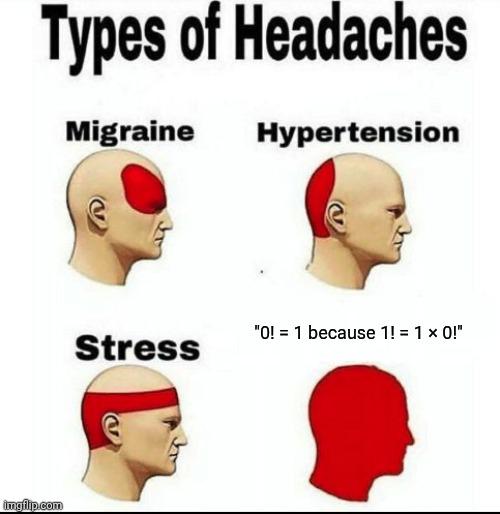
Use The Gamma Function, Use The Symmetry Of The Binomial Coefficient, Use The Taylor Sum, But Please, For The Love Of Euler, Don't Use This Argument For Why 0! = 1

Use The Gamma Function, Use The Symmetry Of The Binomial Coefficient, Use The Taylor Sum, But Please, For The Love Of Euler, Don't Use This Argument For Why 0! = 1
Mathematicians have legitimate, beautiful reasons for why 0! equals 1—the gamma function extension, combinatorial interpretations, the empty product convention—but then someone walks into your office and says "well obviously 0! = 1 because 1! = 1 × 0!" and you can literally feel your brain melting out of your ears. This circular reasoning is the mathematical equivalent of saying "I'm right because I said so." It's like proving water is wet by saying wet things are watery. The argument assumes what it's trying to prove, which is why it causes a full-body headache that makes migraines look like a gentle massage. Fun fact: The real reason 0! = 1 is that there's exactly ONE way to arrange zero objects—by doing nothing. It's the empty arrangement, and it counts. Much more elegant than this recursive nightmare that haunts every math professor's dreams.

At Least For Discrete Distributions

At Least For Discrete Distributions
Behold! The mathematical truth bomb that statisticians don't want you to know! This formula—probability = combinatorics/n—is basically the secret sauce of discrete probability theory. It's that moment when you realize counting possible outcomes and dividing by total outcomes is LITERALLY ALL THERE IS to calculating probabilities for discrete distributions. Mind = blown! 🤯 Try arguing with this definition while standing in front of your probability professor! You'll either get an A+ or be banished from the math department forever. No in-between, just like a Bernoulli distribution!

Power Set Problems: A Mathematician's Terrible Day

Power Set Problems: A Mathematician's Terrible Day
Ever try explaining your day to someone who doesn't speak math? The husband's response is brilliant! 2^N (the power set) versus the natural numbers (N₁, N₂, etc.) - basically saying "my day contained EVERY POSSIBLE COMBINATION of problems!" The power set of N elements has 2^N members, which grows exponentially faster than just counting numbers. Translation: "My day wasn't just bad... it was COMBINATORIALLY CATASTROPHIC!" No wonder mathematicians have trouble with small talk at parties!

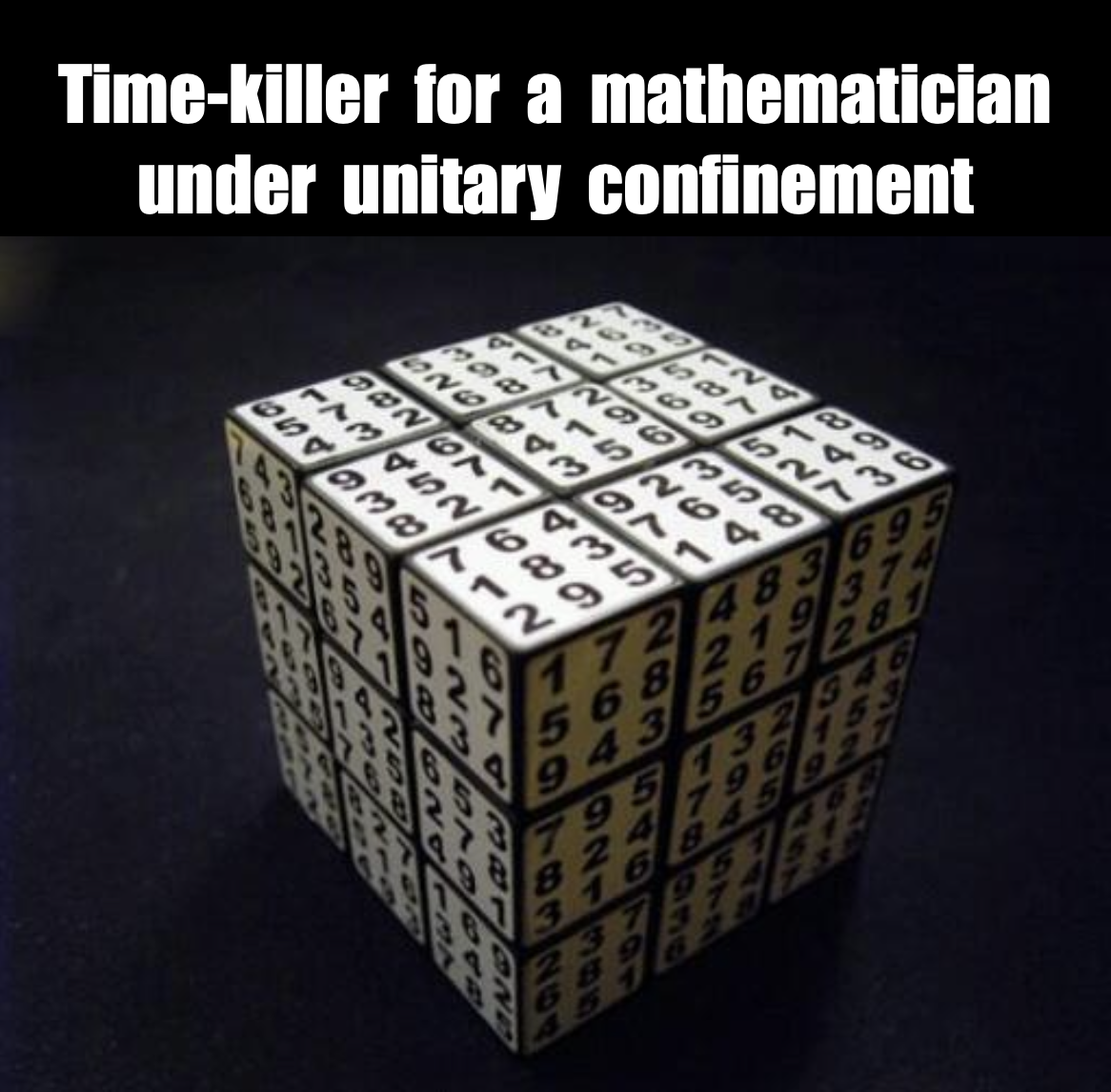
Rubik's Sudokube

Rubik's Sudokube
What happens when you combine two NP-complete problems and make them three-dimensional? Pure mathematical torture. This unholy hybrid of a Rubik's cube and Sudoku would keep even Fields Medal winners occupied for decades. The real challenge isn't solving it—it's explaining to your therapist why you voluntarily subjected yourself to this punishment. Mathematicians call this "recreational" the same way they call proving Fermat's Last Theorem "an interesting afternoon exercise."

The Mathematical Proof Of Rejection

The Mathematical Proof Of Rejection
The paradoxical statement "Not being chosen is being chosen" is actually backed by mathematical proof! The binomial coefficient equation at the bottom (n choose k) = (n choose n-k) shows that selecting k items from a set is mathematically identical to NOT selecting n-k items. So whether you're picking who's on the team or who's sitting out, you're making the exact same mathematical choice. Next time your research proposal gets rejected, just remember - you were mathematically selected for non-selection! It's not a rejection, it's an alternative acceptance!

Combinatorial Enlightenment

Combinatorial Enlightenment
The mathematical formula at the bottom is basically saying "choosing k items from n items is exactly the same as choosing the items you don't want." Just like the samurai contemplating the sunset, mathematicians reach enlightenment when they realize that selecting what to exclude is mathematically identical to selecting what to include. Next time you're rejected from something, remember: they didn't "not choose you" — they mathematically selected you for the complement set. Profound comfort for nerds everywhere.

That's The Mistake I Made When I First Saw A Double Factorial

That's The Mistake I Made When I First Saw A Double Factorial
The mathematical carnage behind this meme is both hilarious and terrifying! In math notation, 10!! (double factorial) means multiplying only even or only odd numbers up to 10, so 10!! = 10 × 8 × 6 × 4 × 2 = 3,840. But if you mistakenly calculate (10!)! (factorial of factorial), you're computing the factorial of 3,628,800... which is a number so astronomically large it would require scientific notation with over 40 million digits. No wonder we'd have flying cars and utopian cities—we'd have unlocked computational power beyond imagination! The difference between these two operations is literally civilization-altering.

I Finally Fw Combinatorics

I Finally Fw Combinatorics
The mathematical poetry of rejection! 🤓 This gem plays with the notation for "n choose k" combinations, which tells us how many ways we can select k items from a set of n items. The joke is that "not being chosen" is technically "being chosen" - just for the complementary set! It's like saying "I wasn't rejected, I was just selected for the group of people who don't get to participate!" Mathematical loopholes for emotional damage! The binomial coefficient notation at the bottom (n k) = (n n-k) is actually a legitimate combinatorial identity showing these are equivalent. Rejection has never been so mathematically elegant!

The Birthday Paradox Game Show Showdown

The Birthday Paradox Game Show Showdown
The infamous Birthday Paradox strikes again! This game show question is brilliantly deceptive. Most people intuitively guess a low probability, but the correct answer is actually C: 50%. With just 23 people, the probability of a birthday match skyrockets to about 50% due to the magic of combinatorics. We're not checking if someone matches a specific date—we're comparing every possible pair among the 23 students (that's 253 different comparisons!). This counterintuitive result is why statisticians make terrible party guests. "Actually, there's a 99.9% chance two people here share a birthday..." *everyone slowly backs away*

Born Just In Time To Pay Taxes

Born Just In Time To Pay Taxes
So your DNA contains more possible combinations than atoms in the universe, yet somehow you were born with the exact genetic sequence that makes you obligated to file tax returns. Talk about cosmic bad luck! With 10^(1.8 billion) possible genetic arrangements, the universe could have made you a tardigrade, a dolphin, or even a tax-exempt nonprofit organization. Instead, it crafted a perfectly functioning human tax payer. Nature's cruelest joke isn't extinction—it's the W-2 form.

Fibonacci's Sequence Goes Viral

Fibonacci's Sequence Goes Viral
This is mathematical inception at its finest! Someone's brilliantly using the Fibonacci sequence (where each number is the sum of the two preceding ones: 1, 1, 2, 3, 5, 8, 13...) to determine their upvote goals! Notice how they're asking for 610, 987, 1597, 2584, and now 4181 upvotes - each perfectly following the sequence! What makes this extra genius is how the post itself is recursively growing like a mathematical fractal - screenshots within screenshots within screenshots! It's like watching the birth of a mathematical universe in Reddit form. Nature uses Fibonacci patterns in flowers and shells, but this mad lad is using it to farm karma!