
Aristotle Memes

Posts tagged with Aristotle
How To Make The Scientific Revolution Happen 1,000+ Years Sooner

How To Make The Scientific Revolution Happen 1,000+ Years Sooner
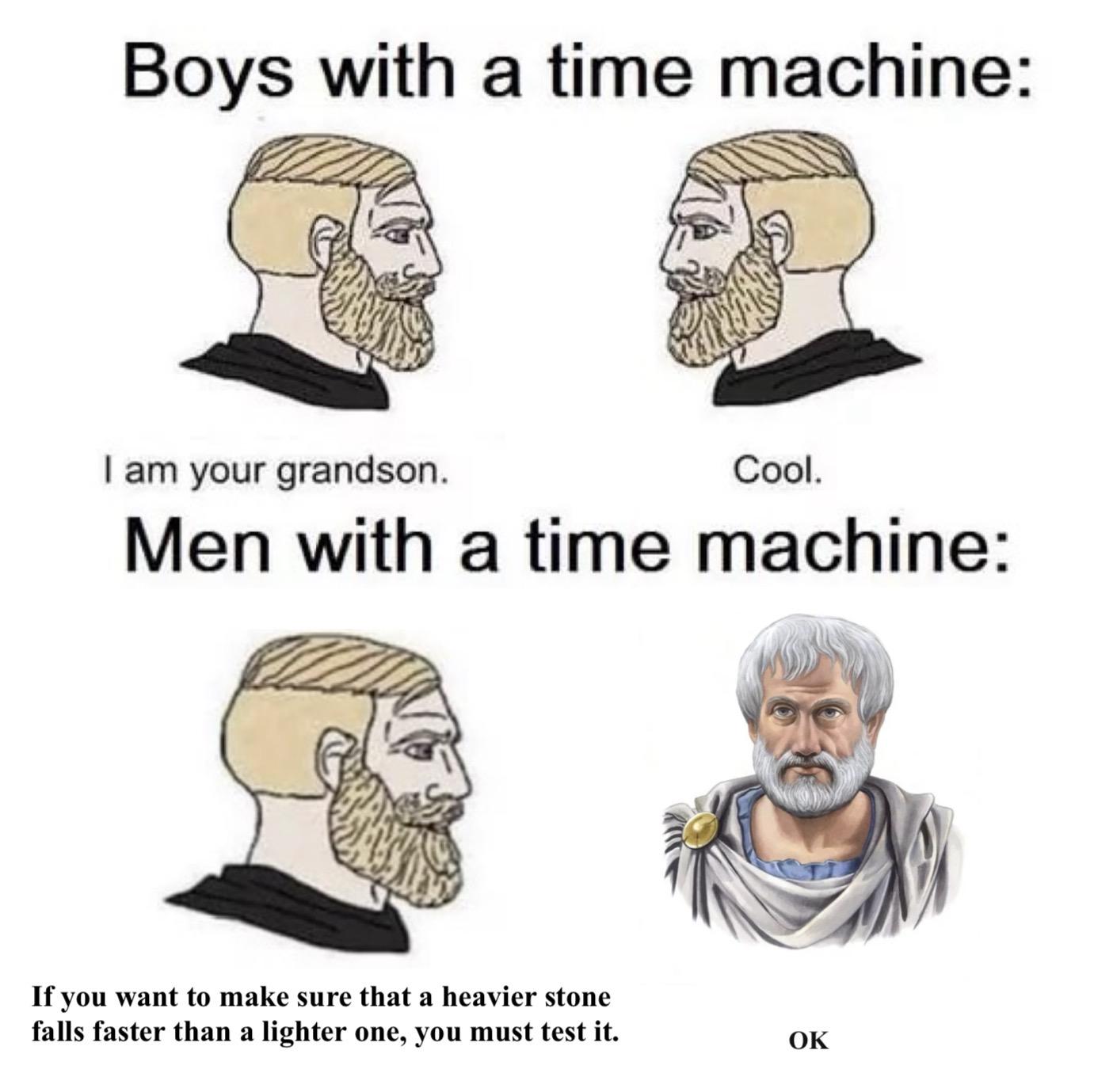
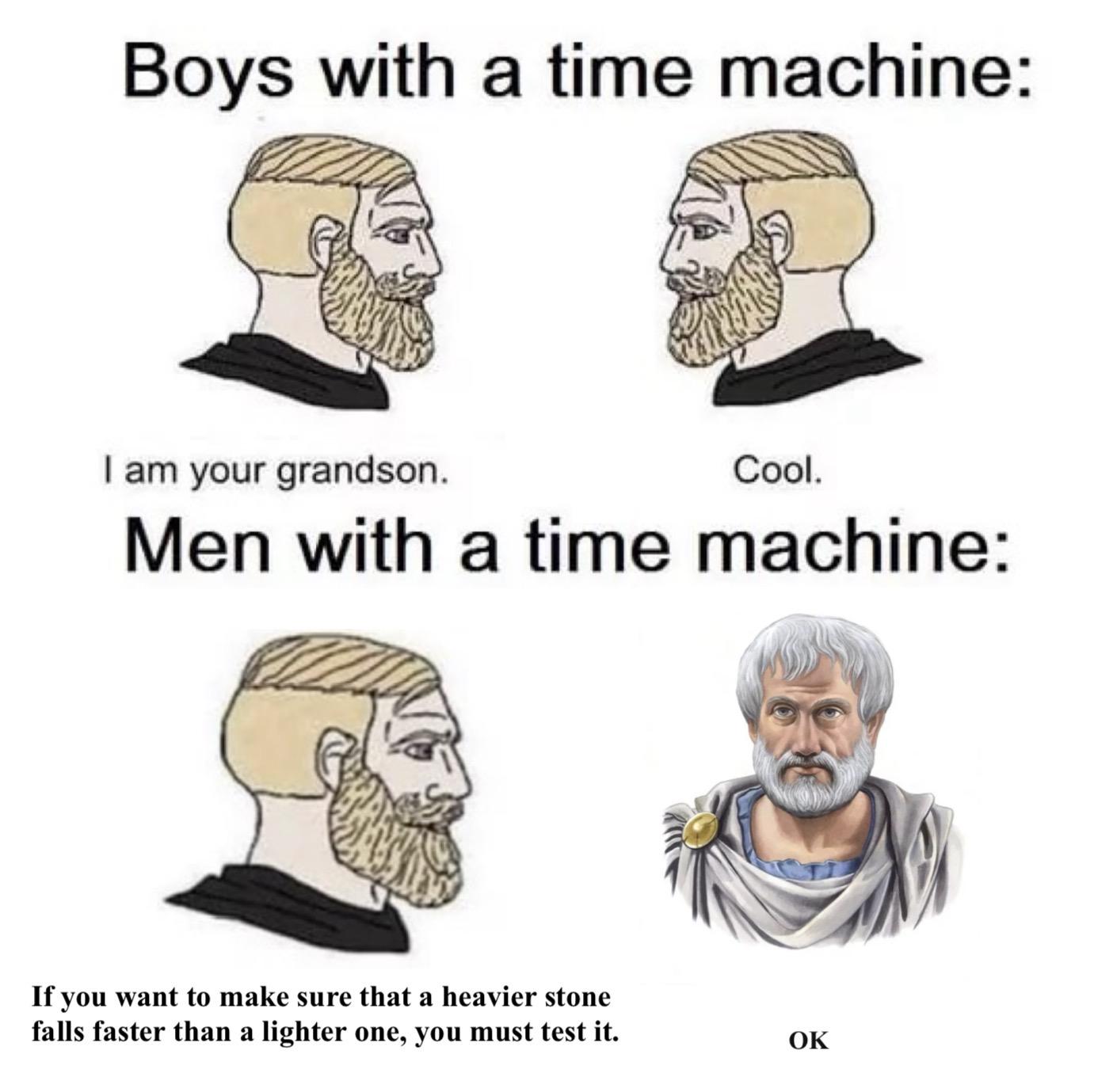
The ultimate time travel priority shift! While teens might waste time on family reunions ("I'm your grandson." "Cool."), real scientists would go straight to ancient Greece and drop some knowledge bombs on Aristotle. Imagine fast-forwarding scientific progress by telling philosophers "Hey, maybe actually TEST your gravity theories instead of just thinking about them?" Galileo didn't disprove Aristotle's falling objects theory until the 1500s—that's over 1800 years of people believing heavier objects fall faster! One quick demonstration could've saved humanity centuries of incorrect physics. Talk about an efficient use of temporal displacement technology!

Time Traveling Physics Nerds Unite

Time Traveling Physics Nerds Unite
The ultimate time travel fantasy—meeting your descendants? Nah. Correcting Aristotle's physics! This meme brilliantly contrasts how different generations would use a time machine. While "boys" simply want to meet their grandson (how adorable), "men" go straight for the scientific jugular by visiting Aristotle to debunk his infamous gravity theory. For context: Aristotle (384-322 BCE) incorrectly believed heavier objects fall faster than lighter ones—a misconception that persisted for nearly 2,000 years until Galileo allegedly dropped objects from the Leaning Tower of Pisa. The modern time traveler's urge to demonstrate this experiment to Aristotle himself is peak scientific nerd fantasy! Aristotle's casual "OK" response is the cherry on top. Like, sure random future person, I'll just casually rewrite my entire understanding of natural philosophy based on your demonstration. No big deal.

Noah's Quantum Ark: When Physicists Disagree

Noah's Quantum Ark: When Physicists Disagree
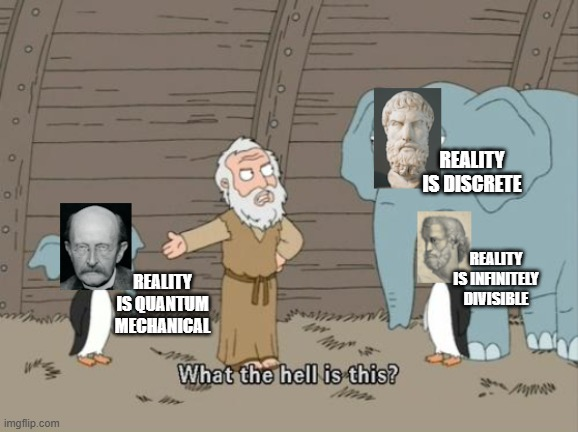
Noah's facing the ultimate physics showdown! Poor guy just wanted to save animals, but instead got Max Planck with "reality is quantum mechanical," Plato declaring "reality is discrete," and Aristotle insisting "reality is infinitely divisible." This is basically every physics department meeting where three professors with competing theories leave everyone else wondering what fresh hell they've walked into. The irony? These ancient debates about the fundamental nature of reality still haven't been resolved. Science: where 2000+ years of arguing gets you... more arguments.

The 2000-Year Fact-Checking Failure

The 2000-Year Fact-Checking Failure
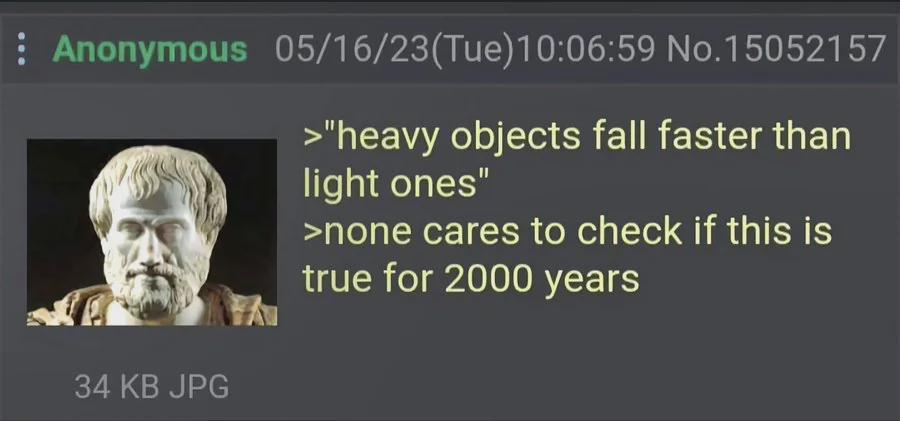
Aristotle really dropped the ball on this one! For two millennia, his unchallenged assertion that heavier objects fall faster than lighter ones was just... accepted. Nobody bothered to climb a tower and drop different weights until Galileo finally said "hold my wine" in the 1500s. Imagine the physics textbooks we could have had if someone had just taken five minutes to fact-check the guy. The scientific method was apparently on a 2000-year coffee break!

Ancient Philosopher Has Cosmic Twitter Meltdown

Ancient Philosopher Has Cosmic Twitter Meltdown
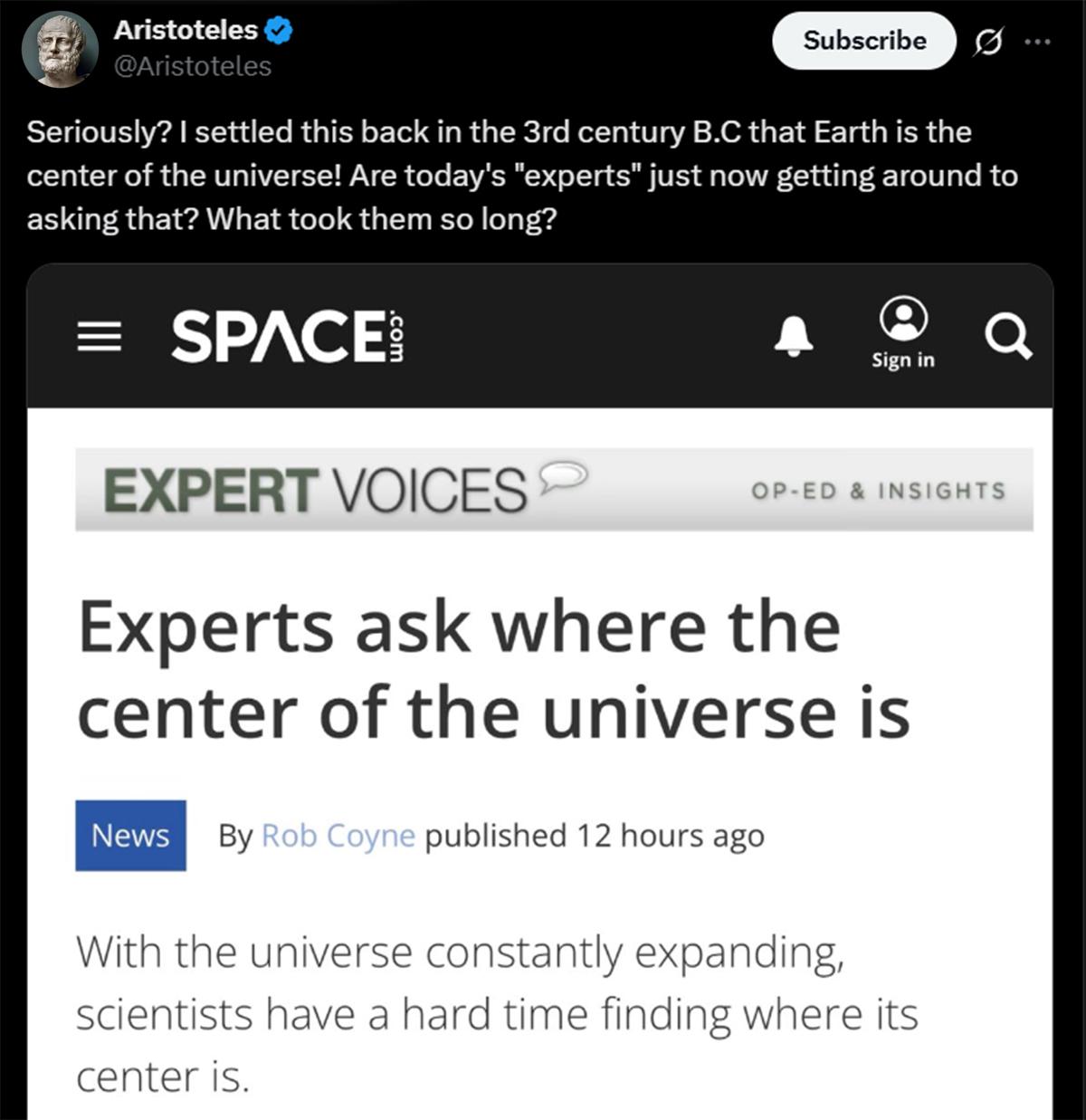
Imagine Aristotle rage-tweeting from the afterlife! Poor guy is having an existential meltdown because modern scientists are questioning something he "settled" 2300 years ago. He's like that friend who insists they discovered a band first, except with COSMOLOGY! 🤣 The universe doesn't actually have a center because it's expanding in all directions like a cosmic soufflé - every point is moving away from every other point. Aristotle's geocentric model was neat and tidy, but turns out the universe is more like my lab after an experiment gone wrong - chaotic, expanding, and impossible to find the starting point!

What Would You Do With A Time Machine?

What Would You Do With A Time Machine?
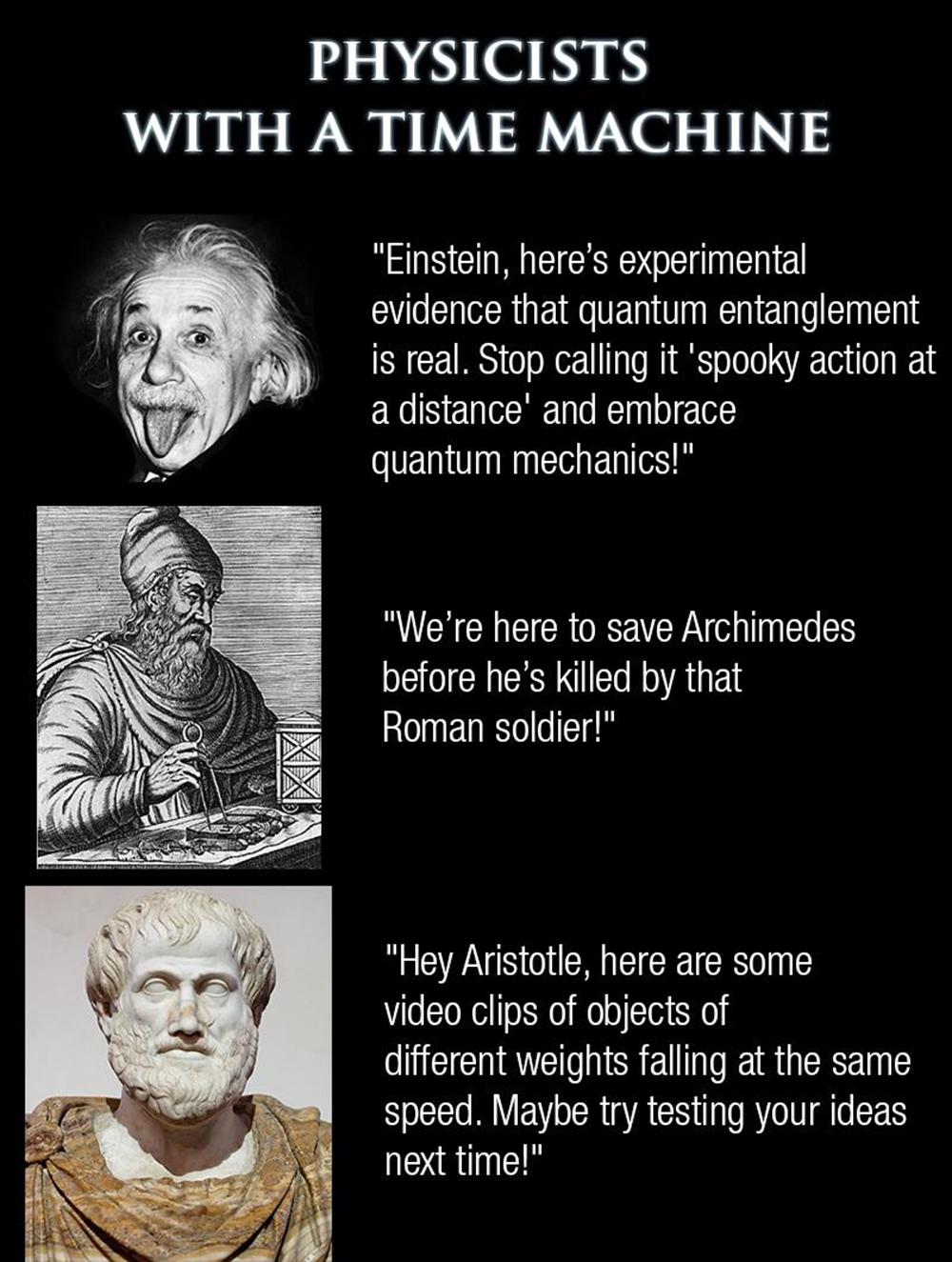
While most people would use time machines to meet their ancestors or bet on sports, physicists have... different priorities. Imagine traveling through spacetime just to win scientific arguments. "Sorry Einstein, but quantum particles really can influence each other instantaneously across vast distances. Here's the Bell test results to prove it." Or saving Archimedes mid-eureka moment because his contributions to calculus were cut tragically short by a Roman soldier. And poor Aristotle getting schooled with Galileo's gravity experiments centuries before they happened. The ultimate "well, actually" move across the space-time continuum.

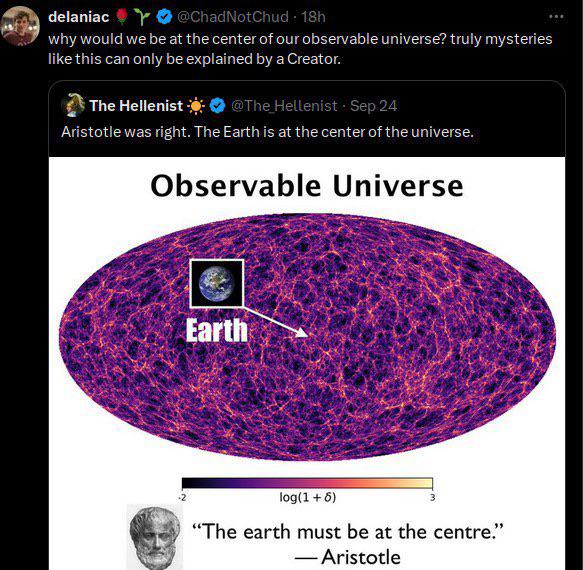
The Cosmic Selfie Paradox

The Cosmic Selfie Paradox
Of course Earth is at the center of the observable universe! That's like being shocked you're at the center of your own selfie! 📸 The cosmic microwave background (that gorgeous purple cosmic web) looks the same in all directions because—PLOT TWIST—the observable universe is literally defined as everything we can see from Earth! It's a giant cosmic sphere with us at the center because light has only had 13.8 billion years to reach us since the Big Bang. Poor Aristotle getting dragged into this! He thought Earth was the center of EVERYTHING, not just our observation bubble. The universe keeps expanding while we're stuck here wondering if we're special. Spoiler alert: we're not! Just victims of perspective!

Physicists With A Time Machine

Physicists With A Time Machine
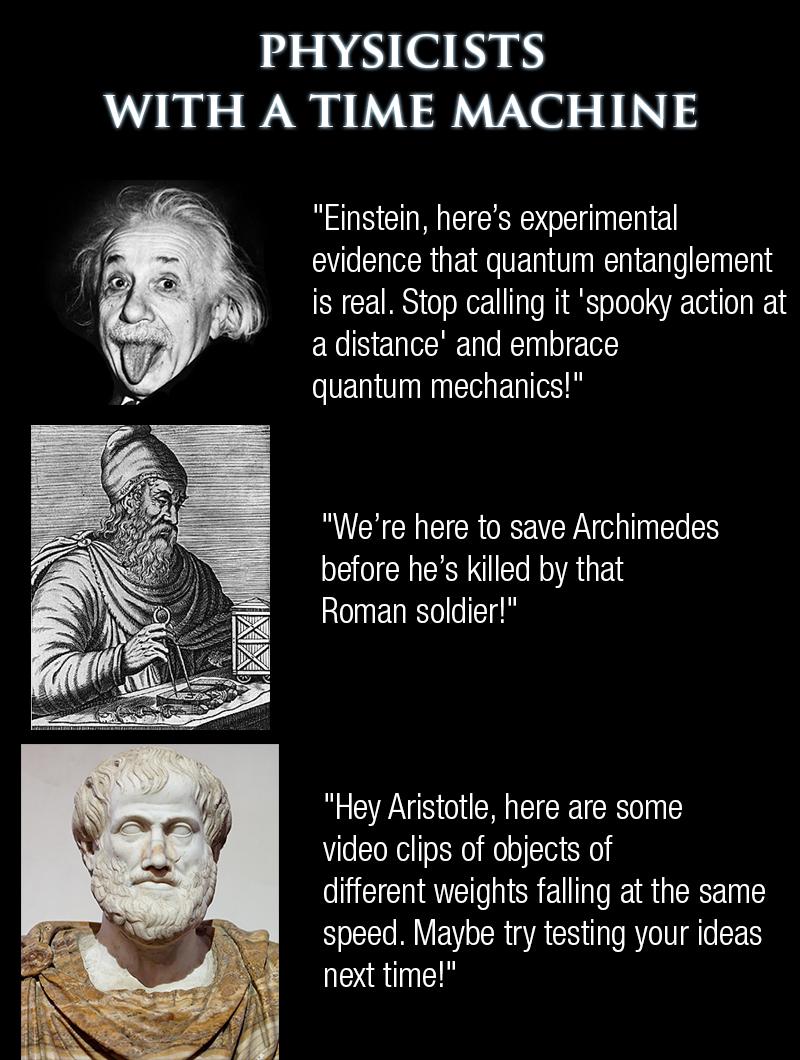
Forget killing Hitler or betting on sports events. Real physicists would use time travel to settle scientific debates and save brilliant minds. Nothing says "I respect the scientific method" like traveling across centuries to show Einstein quantum entanglement evidence, rescue Archimedes from a Roman sword, or passive-aggressively school Aristotle with gravity videos. The ultimate peer review is showing up with future proof and a smartphone. Just imagine the conference papers: "How I Convinced Aristotle Objects Fall at Equal Rates: A Temporal Case Study."

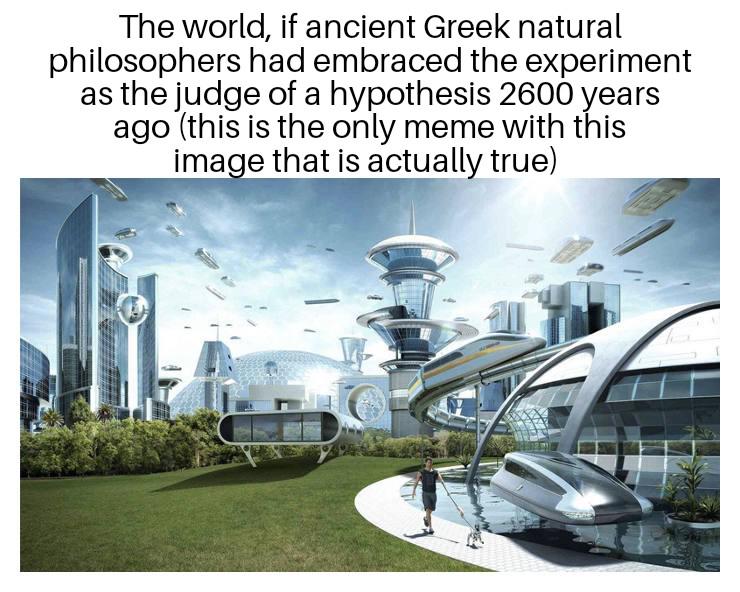
The World If Greeks Had Actually Tested Their Theories

The World If Greeks Had Actually Tested Their Theories
Imagine if Aristotle had been like, "Let's actually TEST whether heavier objects fall faster" instead of just declaring it from his armchair! We'd be zooming around in flying cars by now! Those Greek thinkers were brilliant but skipped the whole "prove it" step that makes science... you know... actually work. 2600 years of technological head start? We'd have colonized three galaxies and cured death by Thursday! Instead, we had to wait for Galileo to drop balls off towers and go "huh, look at that" before science really took off. The ultimate "what could have been" timeline!

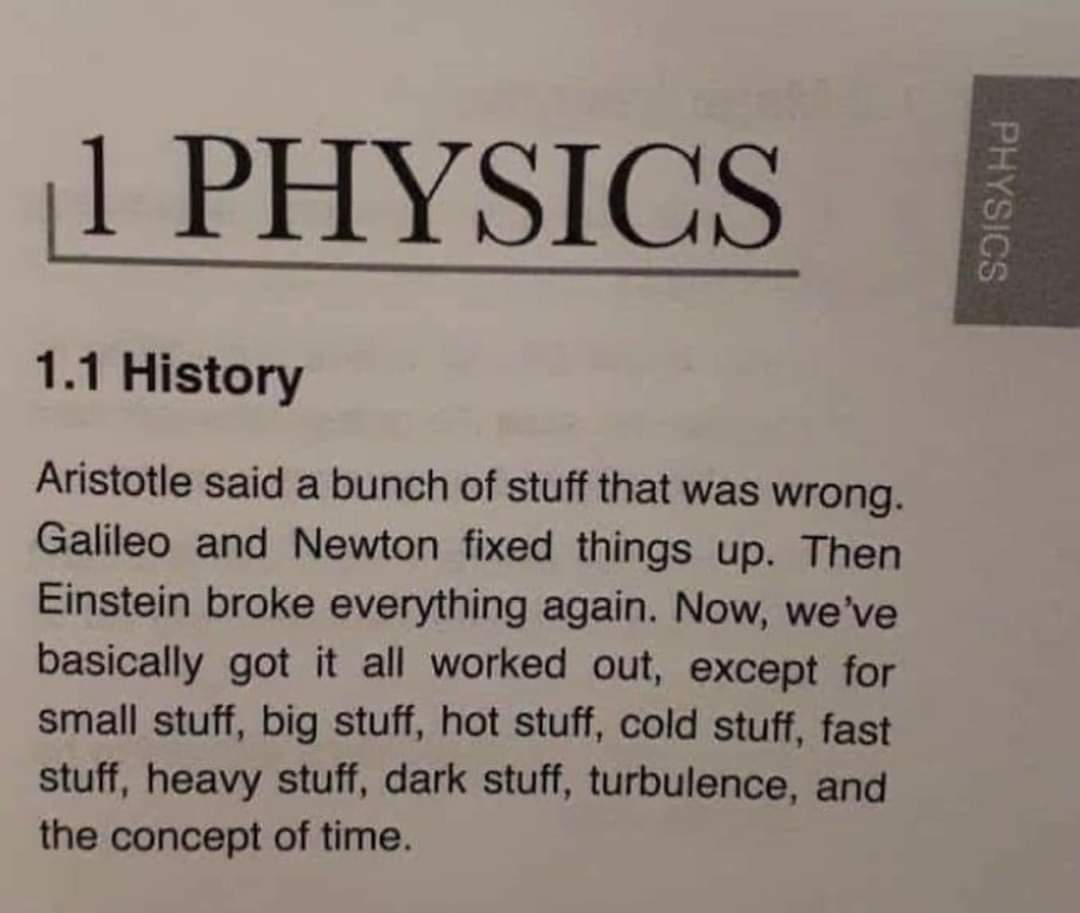
The Most Brutally Honest Physics Textbook Ever

The Most Brutally Honest Physics Textbook Ever
The most brutally honest physics textbook introduction ever written! This perfectly captures the cycle of physics knowledge - centuries of scientists thinking they've figured it all out, only to discover entire new realms of confusion. The casual dismissal of "small stuff" (quantum mechanics), "big stuff" (cosmology), "hot stuff" (thermodynamics), and "the concept of time" (relativity) is pure genius. It's basically saying "we understand physics perfectly... except for literally everything important." Physics in a nutshell: constantly oscillating between "we know everything" and "we know nothing" with increasing precision.

Checkmate, Atheists!

Checkmate, Atheists!
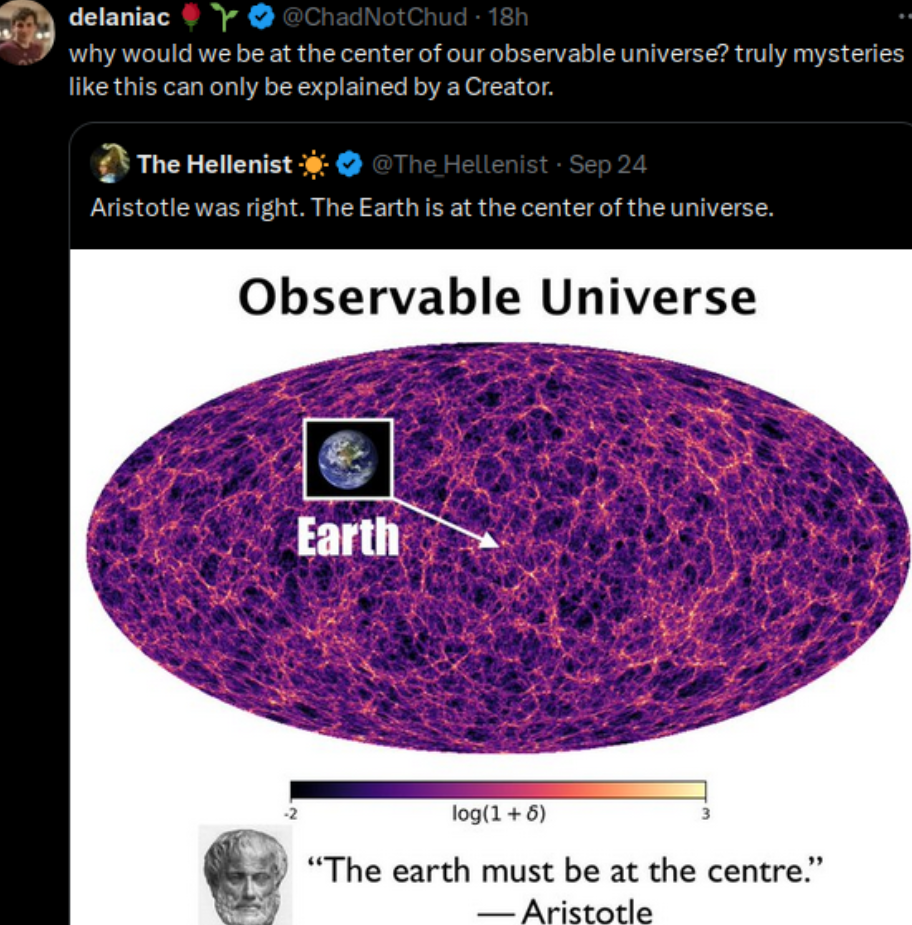
The cosmic irony here is delicious! The meme shows our observable universe with Earth marked at the center, alongside Aristotle's quote about Earth being at the center. But here's the scientific plot twist - Earth does appear to be at the center of our observable universe, but only because light from all directions has taken the same amount of time to reach us! It's like claiming you're the center of a forest because you can only see trees within your line of sight. The cosmic microwave background radiation (that purple web-like structure) looks the same in all directions due to the cosmological principle - no matter where you are in the universe, you'd see yourself as the "center" of your own observable bubble. Aristotle was accidentally right for spectacularly wrong reasons!

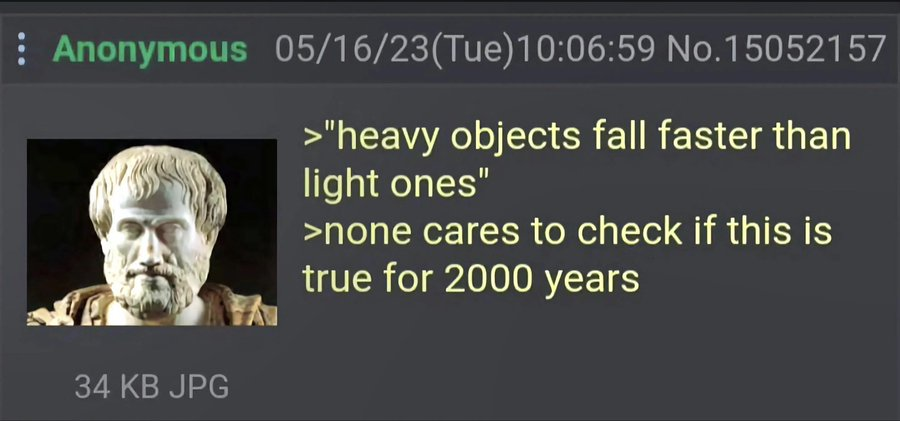
It Seemed Legit

It Seemed Legit
Aristotle's "heavier objects fall faster" theory went unchallenged for two millennia because apparently nobody thought to drop two different weights from a height and time them. Science was basically "sounds right, publish it" back then. Galileo finally did the experiment and was like "um, actually..." and revolutionized physics. Just imagine 2000 years of scholars nodding sagely at something a five-year-old with a rock and a feather could disprove.