

Algebra Memes

Posts tagged with Algebra
We All Did This When Moving A Graph

We All Did This When Moving A Graph
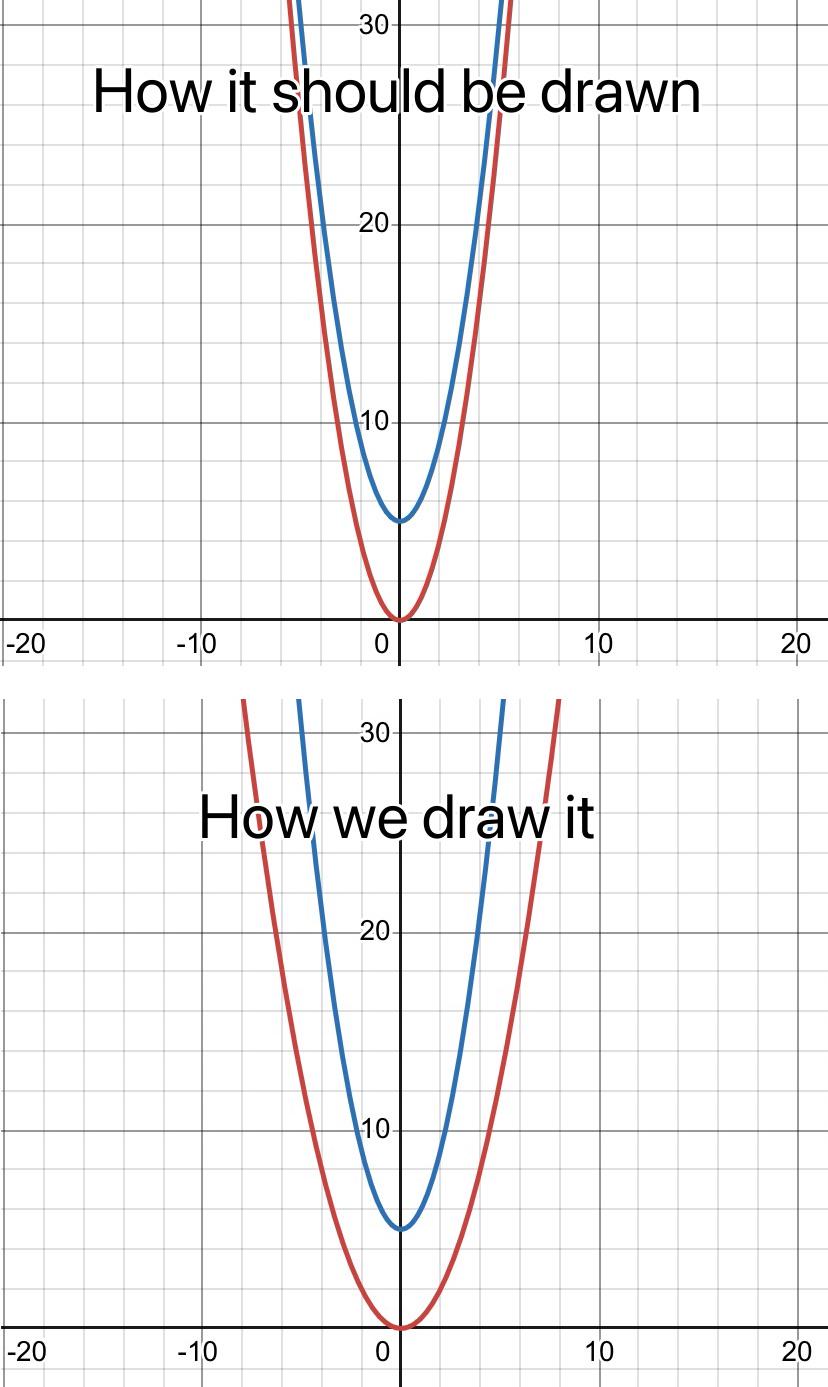
You know that moment when you're supposed to shift a parabola horizontally but your hand just... refuses to cooperate? The top shows these beautiful, smooth curves properly translated along the x-axis like civilized mathematical functions. The bottom? That's what happens when your brain knows the theory but your hand is like "nah, I'm gonna make these curves look like they went through a blender." The struggle is real when you're trying to maintain that perfect parabolic shape while sliding it over. Instead of a clean horizontal translation, you end up with wobbly lines that look like you drew them during an earthquake. Your professor wanted f(x-3), but you delivered f(x-3) drawn by someone on a caffeine withdrawal. Pro tip: This is why graphing calculators exist. Because apparently asking humans to maintain curve integrity while moving their pencil sideways is like asking a cat to take a bath—theoretically possible, practically disastrous.

What Do You Think?

What Do You Think?
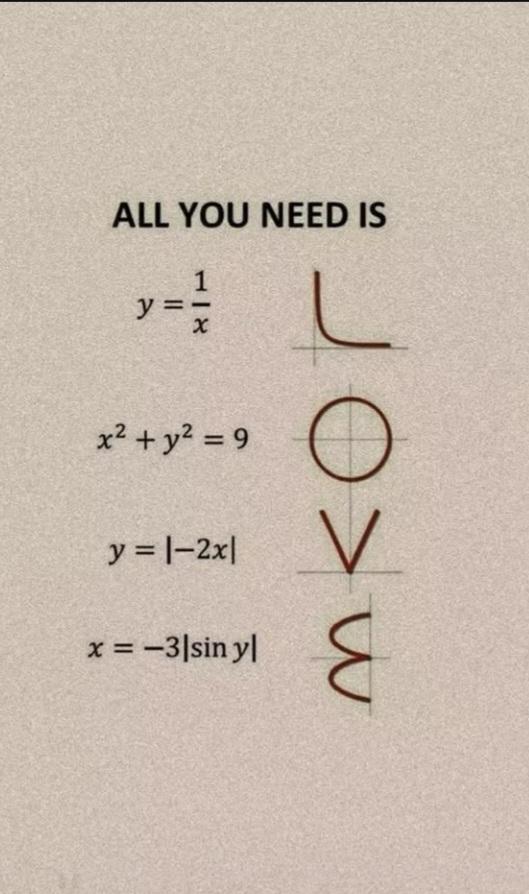
This is basically the mathematical equivalent of "all you need is love" but for nerds who get weirdly excited about graphing calculators. Each equation literally spells out L-O-V-E when you plot them: the hyperbola curves into an L, the circle makes a perfect O, the absolute value function creates a V, and that sine function wraps around into an E. It's the kind of thing that makes math teachers tear up and put on their classroom walls, while simultaneously making students realize their professor has way too much free time. Honestly though, whoever first figured this out probably spent an entire weekend playing with Desmos instead of grading papers, and you know what? Respect.

Take Care Of Your Equation's Mental Health

Take Care Of Your Equation's Mental Health
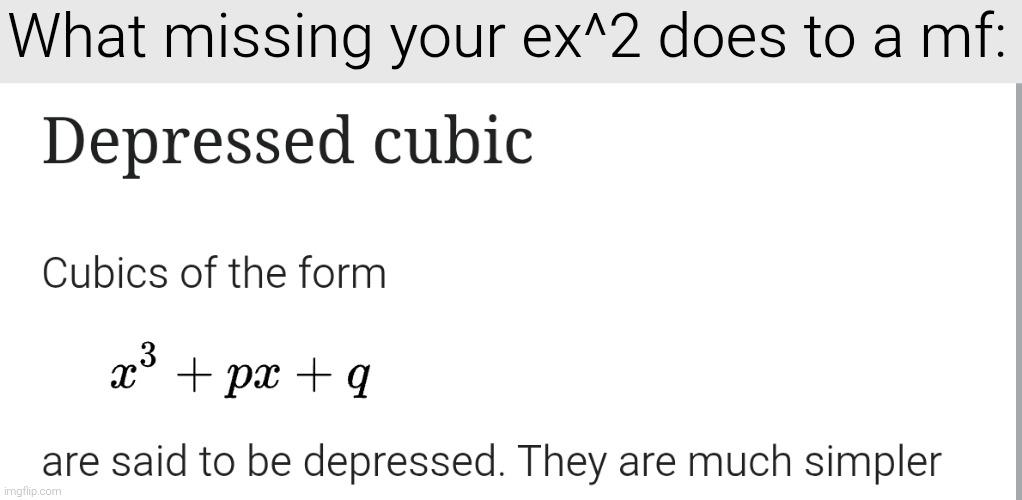
So apparently in math, when you're missing that x² term in your cubic equation, it's called a "depressed cubic." Like, mathematicians really looked at x³ + px + q and said "yeah, this polynomial needs therapy." The joke here is that your equation is literally experiencing mathematical depression because it's missing its middle child—the x² term. It's simpler to solve (which is actually true!), but at what emotional cost? Fun fact: Depressed cubics are actually super useful because any cubic equation can be transformed into this "depressed" form, making them way easier to solve. So basically, sometimes you gotta go through depression to find your roots. Deep.

What Happened To The Cookies?

What Happened To The Cookies?
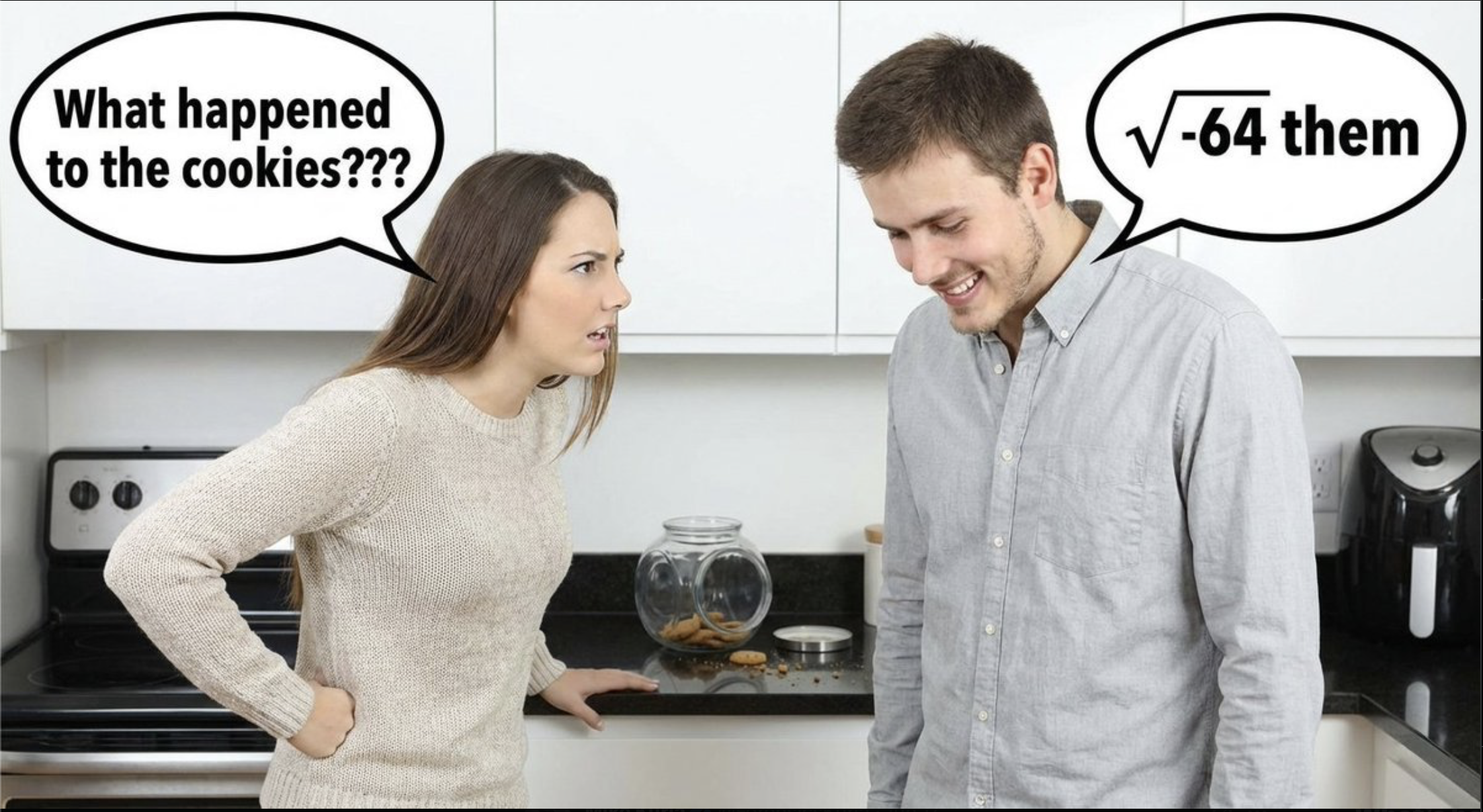
Someone just weaponized imaginary numbers to dodge accountability for eating cookies. The square root of -64 is 8i (where "i" is the imaginary unit), so he's saying "I ate them" but with extra mathematical flair. It's the nerd equivalent of "I plead the fifth" except you're flexing your complex number knowledge while confessing to cookie theft. The beauty here is that √-64 requires you to venture into the realm of imaginary numbers since you can't take the square root of a negative number in the real number system. So technically, he's admitting guilt while simultaneously showing off that he remembers his high school algebra. That smirk says it all – he knows exactly what he did, and he's proud of the delivery.

Formula Fanatics Are An Absolute Disgrace

Formula Fanatics Are An Absolute Disgrace
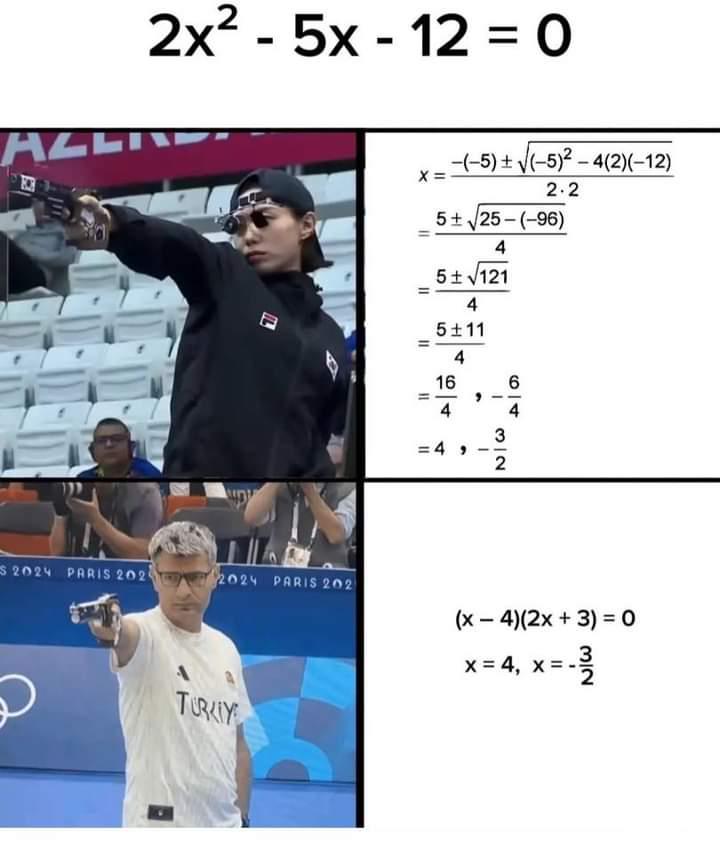
There are two types of people in this world: those who memorize the quadratic formula like it's their social security number, and those who just factor the damn thing and move on with their lives. The top panel shows someone grinding through the quadratic formula like they're defusing a bomb—calculating discriminants, simplifying radicals, doing arithmetic gymnastics. Meanwhile, the bottom panel casually factors the same equation in literally two seconds: (x - 4)(2x + 3) = 0. Done. Dusted. No drama. It's the mathematical equivalent of using a sledgehammer to crack a walnut when you could just... use your fingers. Sure, the quadratic formula works every time, but when your equation factors this cleanly? You're just showing off your ability to suffer unnecessarily. Factoring gang stays winning with minimal effort and maximum smugness.

Teenagers Vs. Basic Algebra

Teenagers Vs. Basic Algebra
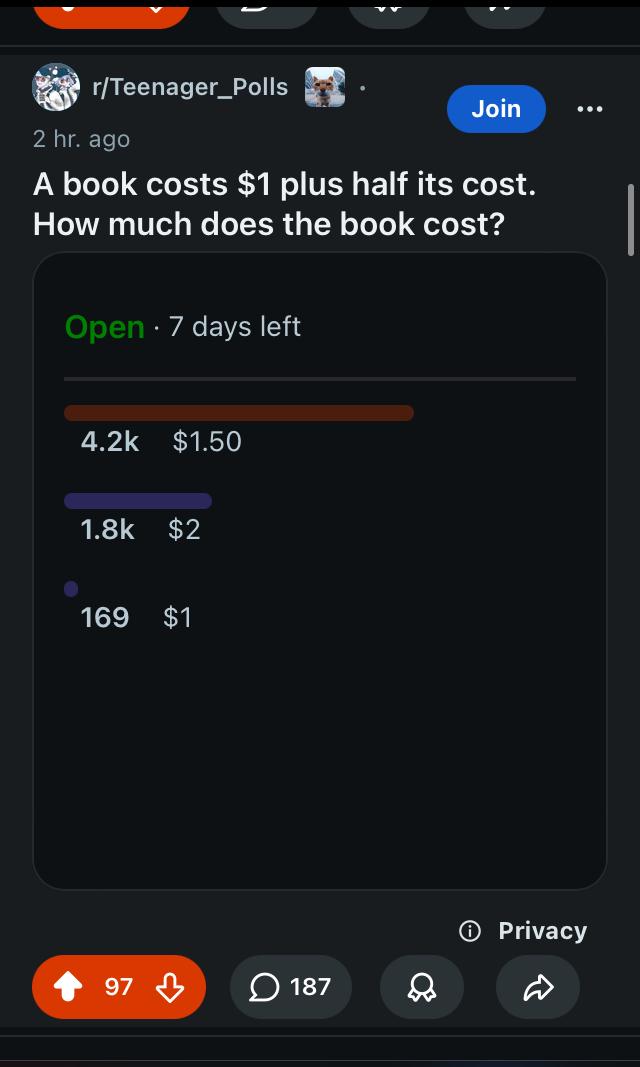
Let's set up the equation: x = $1 + 0.5x. Subtract 0.5x from both sides, get 0.5x = $1, therefore x = $2. It's literally one of the simplest algebra problems you can give someone. But here's where it gets beautiful: 4,200 teenagers confidently voted for $1.50, which would mean the book costs $1.50 and half its cost is $0.75, giving us a total of... $2.25. Not $1.50. The math isn't mathing, folks. The 1,800 people who voted $2 are sitting there like "did everyone else skip 7th grade?" Meanwhile, 169 brave souls chose $1, presumably thinking the book just costs itself plus... nothing? The confidence-to-correctness ratio in online polls never fails to deliver existential dread about our collective future.

Today I Woke Up And Realized Mind Your Decisions Is Pure Math Slop

Today I Woke Up And Realized Mind Your Decisions Is Pure Math Slop
The eternal battle between clickbait math content and actual mathematical rigor. MindYourDecisions has mastered the art of making viral "brain teaser" videos that are basically just arithmetic dressed up as profound puzzles, while channels like Andy Math are out here doing the unglamorous work of teaching actual mathematical concepts that require, you know, thinking beyond third grade. It's like comparing fast food to a home-cooked meal. Sure, MindYourDecisions will get millions of views with "97% of people can't solve this!" thumbnails featuring some basic algebra problem, but Andy Math is teaching calculus, linear algebra, and differential equations to students who actually need to pass their exams. One's optimized for the algorithm, the other's optimized for learning. The "send him 2-3 years and forget" part is chef's kiss—because that's exactly how long it takes to realize that those viral math puzzles didn't actually teach you anything useful when you're staring down a real analysis exam.

Remember What Set You're Working In!

Remember What Set You're Working In!
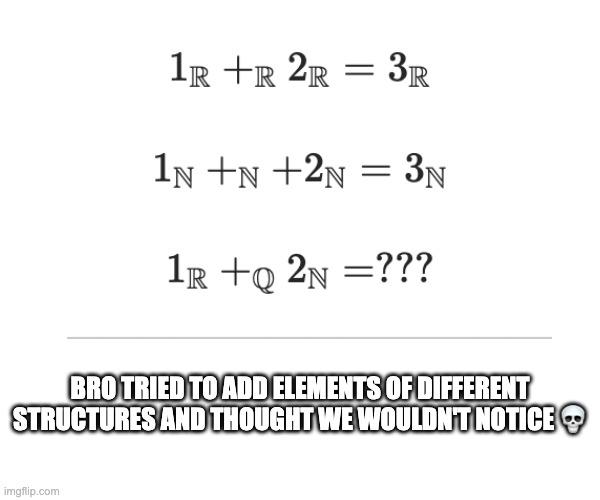
This is what happens when you forget that mathematical sets have rules, and you can't just mix and match like you're making a smoothie. The first two equations work perfectly because they're adding elements within the same set (real numbers ℝ and natural numbers ℕ), but then someone tried to add 1 from the reals with 2 from the naturals using different subscripts and... chaos ensued. It's like trying to add apples to oranges, except mathematicians get REALLY upset about it because they spent centuries building these beautiful, organized structures. The skull emoji at the end perfectly captures the existential dread of realizing you've been mixing elements from different algebraic structures like some kind of mathematical barbarian. Fun fact: This is actually a real problem in abstract algebra and set theory. You can't just arbitrarily combine elements from different sets without defining proper operations between them. Your professor would give you that look—you know the one.

The Quintic Formula

The Quintic Formula
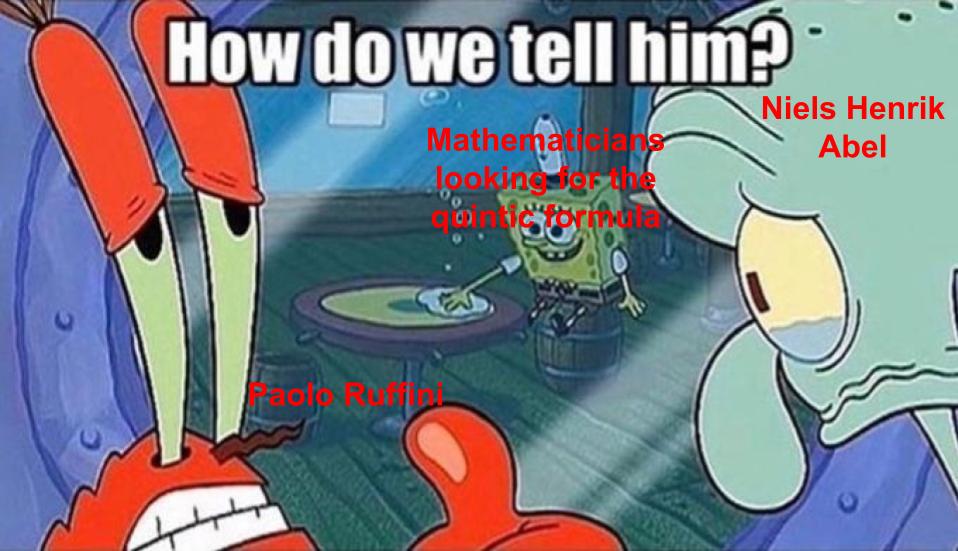
So here's the tea: mathematicians have nice formulas for solving quadratic, cubic, and even quartic equations. But when it comes to quintic equations (5th degree polynomials)? Niels Henrik Abel literally proved in 1824 that there's NO general algebraic formula for them. It's mathematically impossible! Meanwhile, Paolo Ruffini proved the same thing earlier in 1799 but nobody believed him because his proof was kinda messy. Poor guy was basically ghosted by the math community. Now both mathematicians are staring at their colleagues still desperately searching for something that provably doesn't exist, like watching someone look for their glasses while wearing them. The SpongeBob "How do we tell him?" format hits different when you've already published the proof but everyone's still in denial. It's giving "I already did the homework and you're all wasting your time" energy.

"Stop Using Complex Numbers" They Say

"Stop Using Complex Numbers" They Say
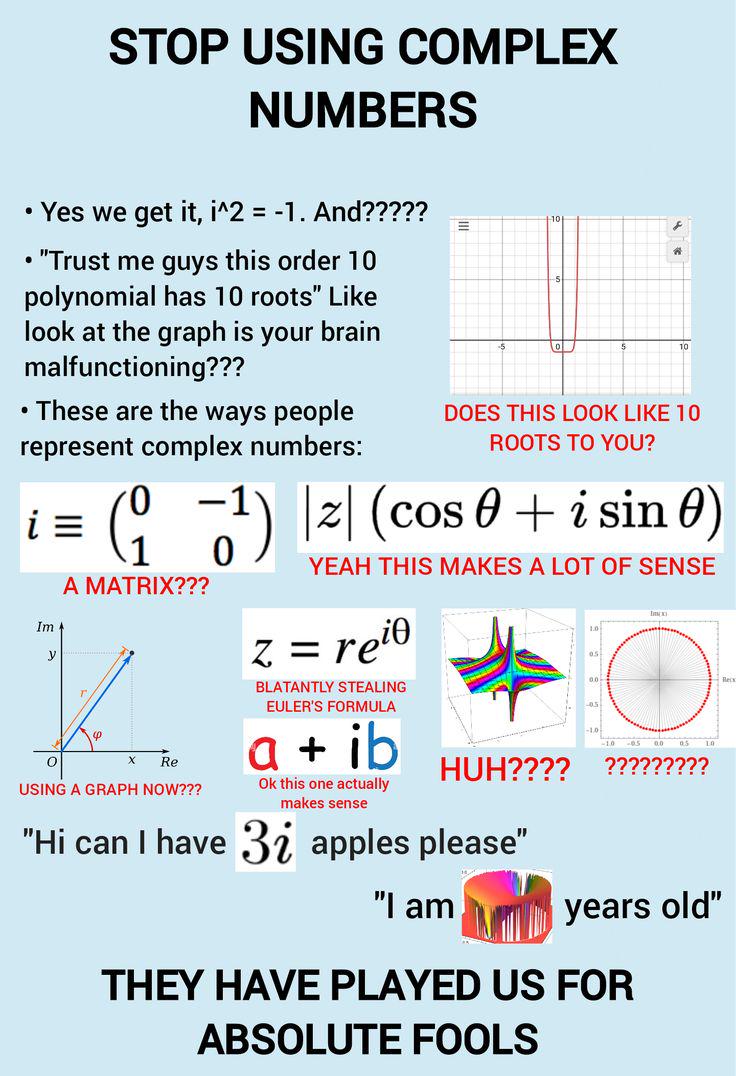
Imagine telling mathematicians and physicists to stop using complex numbers. That's like asking a chef to stop using salt—technically possible, but why would you torture yourself? The beautiful chaos here showcases every possible way to represent complex numbers, and people STILL get confused. You've got the algebraic form (a + bi), Euler's magnificent formula (which is basically the mathematical equivalent of a mic drop), polar coordinates, matrix representation, and some absolutely cursed 3D visualizations that look like modern art had a baby with a calculus textbook. The real kicker? That polynomial graph showing what LOOKS like only 2 roots when there are actually 10 hiding in the complex plane. It's like playing hide-and-seek where most of the players are invisible to people who refuse to acknowledge imaginary numbers exist. And don't even get me started on "3i apples" and being "weird colorful graph" years old. Complex numbers are literally everywhere in quantum mechanics, electrical engineering, and signal processing. Without them, your WiFi wouldn't work and Schrödinger's cat would be very disappointed.

Giga Chads Derive Everything During An Exam

Giga Chads Derive Everything During An Exam
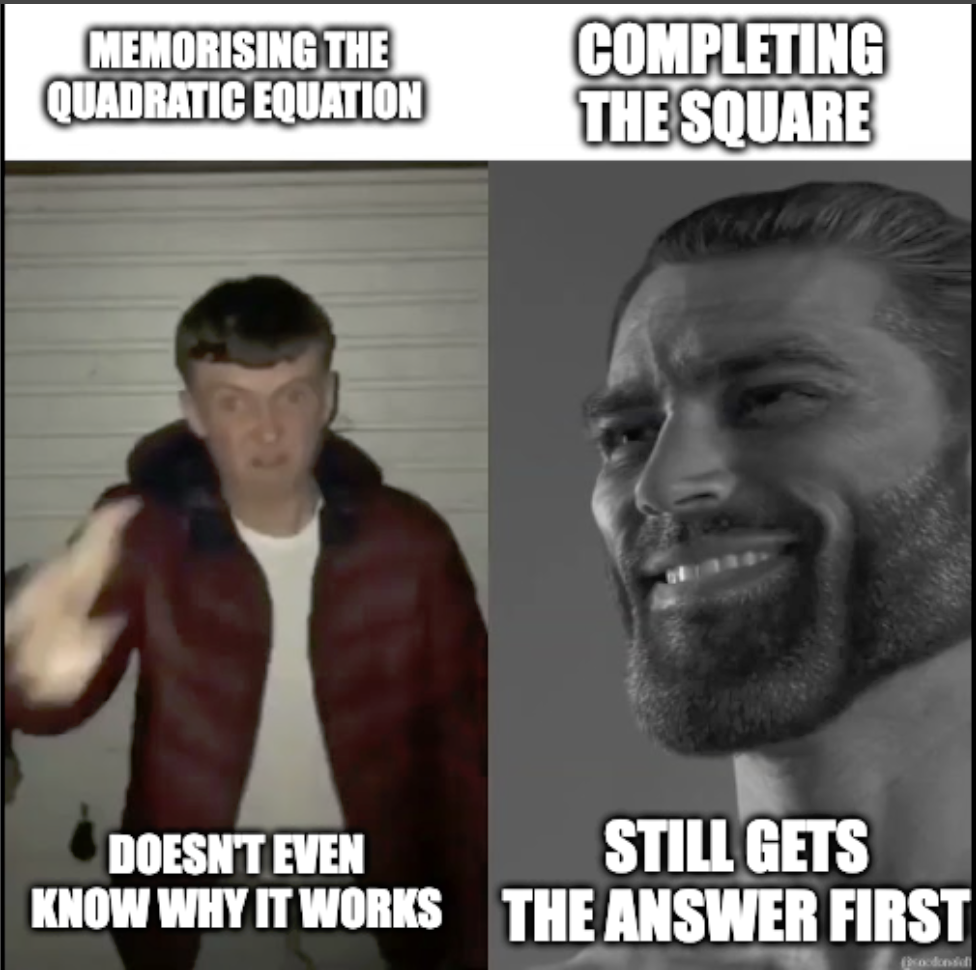
You know that kid who just casually derives the quadratic formula from scratch during a calculus exam while you're frantically trying to remember if it's "minus b plus or minus" or "plus b minus or minus"? Yeah, they're built different. Completing the square is actually the OG method behind the quadratic formula—it's where the whole thing comes from. Instead of memorizing that intimidating formula, true mathematical warriors just start with ax² + bx + c = 0 and work their way through the algebraic gymnastics right there on the exam paper. They finish first, get full marks, and probably don't even understand why everyone else looks so stressed. Meanwhile, the rest of us are sweating bullets trying to plug numbers into a formula we memorized at 2 AM, still not entirely sure why there's a discriminant or what "completing the square" even means. But hey, at least we knew enough to memorize something, right? Right?

Complex Number Meme

Complex Number Meme
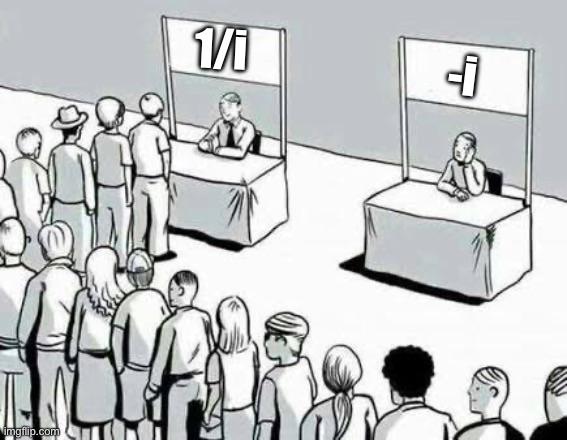
So you've got two mathematicians at convention booths here, and the popularity difference is BRUTAL. The booth for 1/i is absolutely packed with fans, while poor -i is sitting alone like the loneliest number (which is technically one, not -i, but whatever). Here's the kicker: 1/i and -i are literally the SAME number! If you multiply both numerator and denominator of 1/i by i, you get i/i² = i/(-1) = -i. They're identical, just wearing different outfits. It's like when a band releases the exact same song under two different names and one goes viral while the other flops. Marketing matters, even in mathematics! The fraction form 1/i just LOOKS more approachable and less intimidating than that grumpy negative sign in front of i. Perception is everything, folks—even when you're dealing with imaginary numbers that don't exist on the real number line anyway. 😂