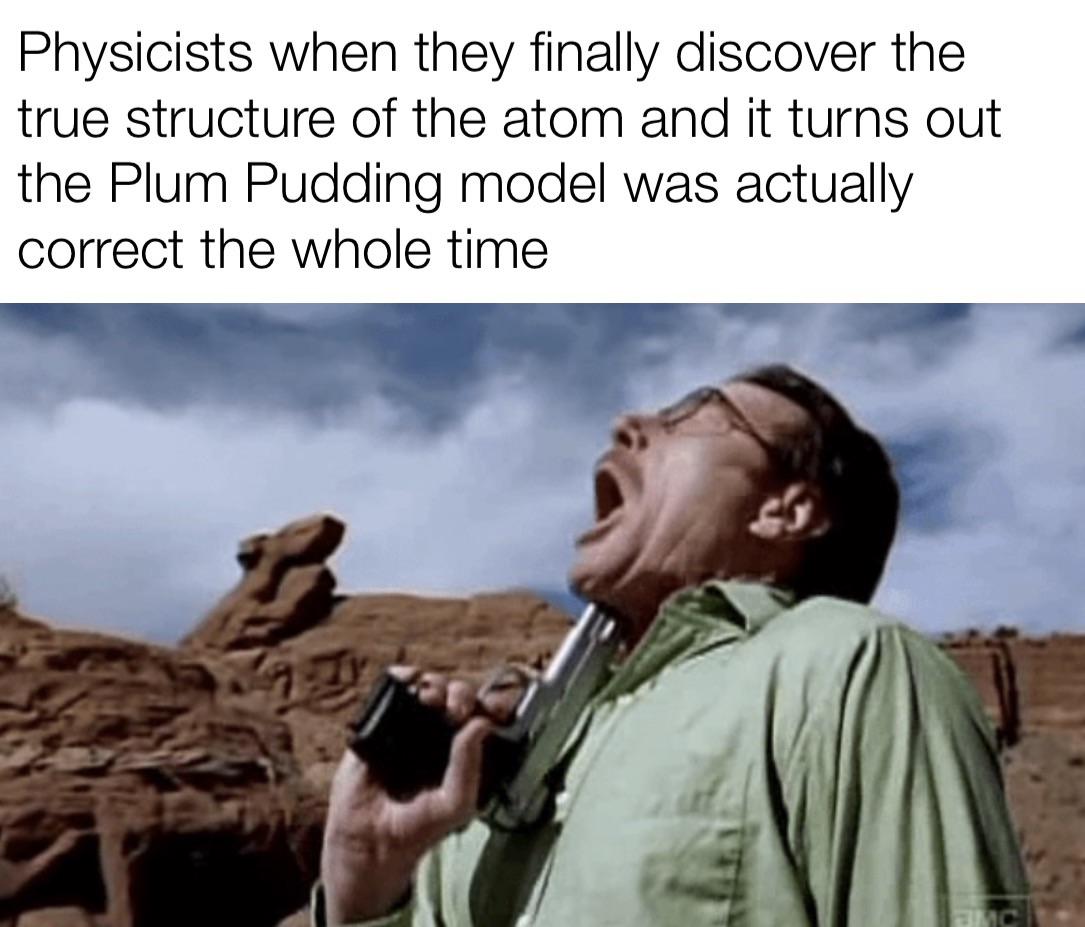
Imagine spending decades mastering quantum mechanics, particle physics, and sophisticated mathematical models, only to find out that J.J. Thomson's 1904 "plum pudding" model—where electrons are just scattered through a blob of positive charge like raisins in a dessert—was somehow the accurate one all along. You know, the model we literally teach in intro physics as "here's what people thought before they knew better." The existential horror of realizing your entire career of increasingly complex atomic models (Rutherford, Bohr, quantum mechanical) was just humanity overcomplicating a Victorian-era pudding analogy. All those particle accelerators? Unnecessary. That PhD thesis on electron orbitals? Worthless. Should've just stuck with dessert-based physics. Plot twist: this will never happen because Rutherford's gold foil experiment definitively yeeted the plum pudding model into the scientific graveyard in 1909, but the fantasy of all that education being pointless? That's the real nightmare fuel for any physicist.

 Academia
 Ai
Ai
 Astronomy
 Biology
 Chemistry
 Climate
 Conspiracy
 Earth-science
 Engineering
 Evolution
 Geology