
Covalent Memes

Posts tagged with Covalent
The Strongest Bond In All Of Chemistry

The Strongest Bond In All Of Chemistry
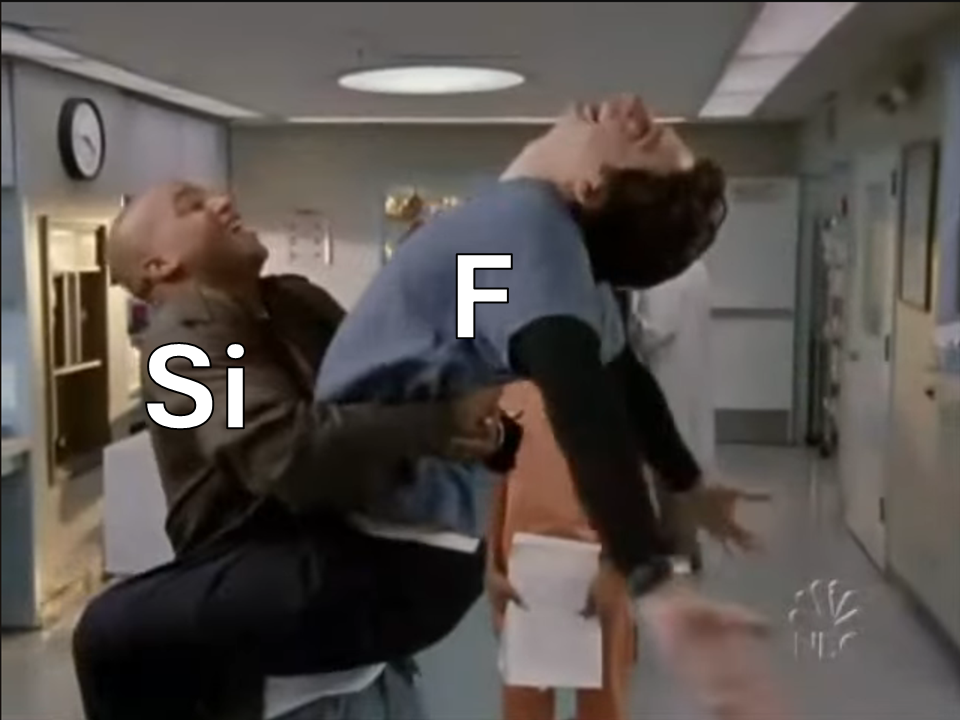
Silicon-Fluorine (Si-F) bonds don't mess around! While carbon compounds are out here having relationship drama, Si-F is in a committed relationship with a bond strength of ~565 kJ/mol. It's literally so clingy that chemists call it "hypervalent." These two elements see each other and it's just *chef's kiss* electronegativity perfection. The meme brilliantly shows two people absolutely losing their minds with joy - just like Si and F atoms when they find each other in solution. Not even water can tear these two apart. Talk about relationship goals that most organic chemists can only dream of synthesizing!

The Bond Is Just Weak

The Bond Is Just Weak
Chemistry romance drama at its finest! The couple sharing that intimate moment represents a covalent bond - where atoms share electrons and form strong, stable connections. Meanwhile, Wolverine lurking in the corner represents the Van der Waals force - those weak, temporary attractions that happen between molecules when they get close but aren't committed enough for a real bond. Basically, covalent bonds are in a serious relationship while Van der Waals forces are just casual flirting from across the room. No wonder Wolverine looks jealous - he'll never experience that electron-sharing intimacy!

The Molecular Throuple Nobody Talks About

The Molecular Throuple Nobody Talks About
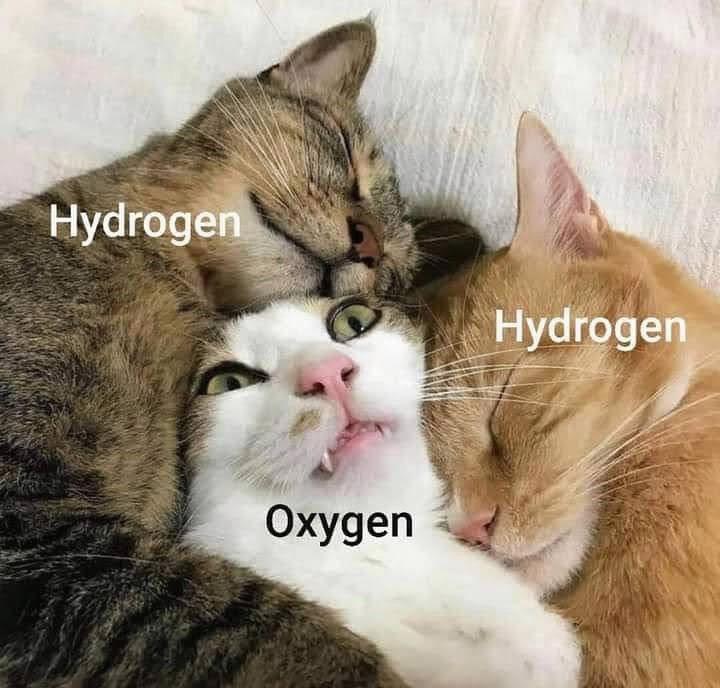
Poor oxygen atom, forever stuck in a three-way relationship it never asked for! In water molecules (H₂O), the oxygen is literally sandwiched between two clingy hydrogen atoms that won't leave it alone. The white cat's face says it all—that's the look of an atom that just wanted some personal space but ended up with two hydrogen atoms all up in its electron cloud. Chemistry's most famous throuple has trust issues too—those hydrogen atoms are positively charged and desperately grabbing at oxygen's electrons. Talk about a toxic relationship! No wonder water is such a drama queen in chemistry experiments.

The Existential Crisis Of Hydrogen

The Existential Crisis Of Hydrogen
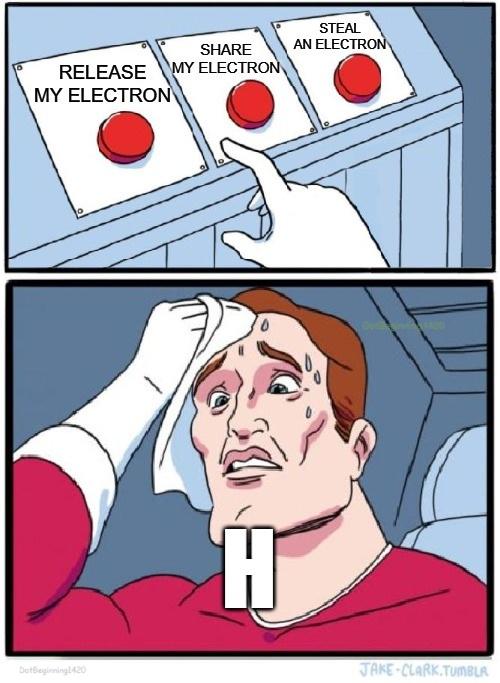
The eternal struggle of hydrogen atoms! Three chemical relationship options but only one electron to give! Release it completely? Share it in a covalent bond? Or go full villain and steal someone else's? No wonder poor H is sweating—it's basically speed-dating at the atomic level with commitment issues. The ultimate chemical dilemma that's been causing anxiety since the periodic table was invented!

The Existential Crisis Of Hydrogen

The Existential Crisis Of Hydrogen
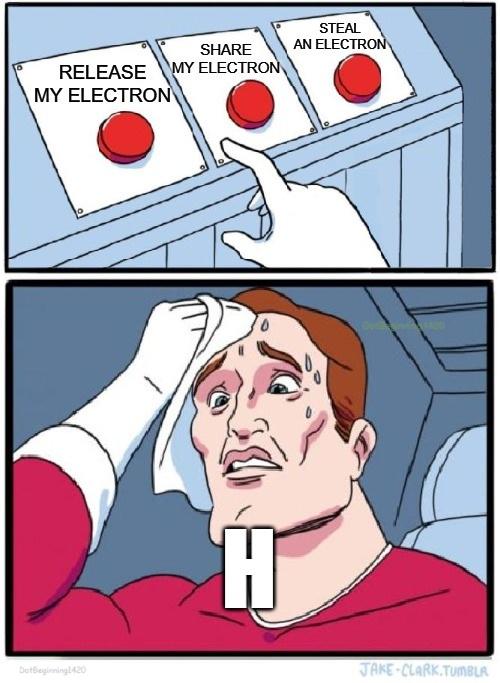
The existential crisis of hydrogen atoms is real! This poor H atom is sweating bullets trying to decide between releasing, sharing, or stealing an electron. It's basically the atomic version of "fight, flight, or make friends." Chemistry students know the struggle - hydrogen can form cations (H+) by releasing electrons, covalent bonds by sharing electrons, or even become hydride (H-) by stealing electrons. No wonder this atom is having a meltdown! It's like being at a chemical buffet with too many reaction pathways and not enough valence electrons to go around.

How I Remember My Atomic Bonds

How I Remember My Atomic Bonds
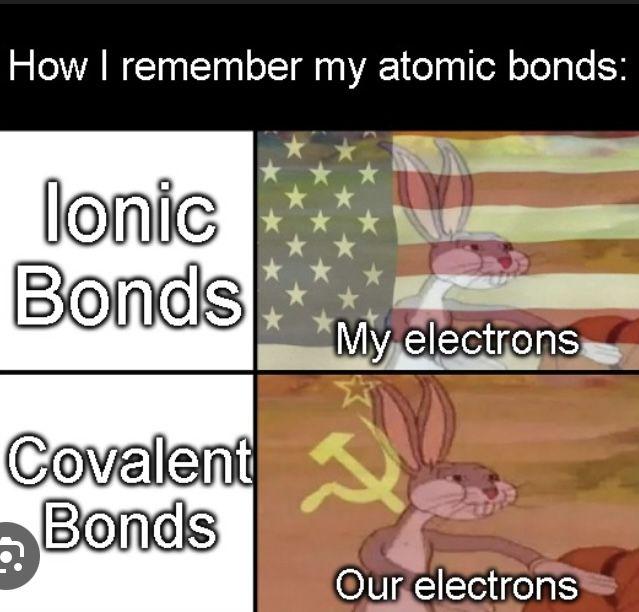
Chemistry students using Cold War propaganda to remember bond types is peak academia. Ionic bonds: electrons get completely transferred from one atom to another (capitalist "my electrons"). Covalent bonds: electrons are shared between atoms (communist "our electrons"). The mnemonic works because you'll never forget the rabbit's face when it realizes its valence shell is being collectivized.

Chemical Bonds Make Terrible Passwords

Chemical Bonds Make Terrible Passwords
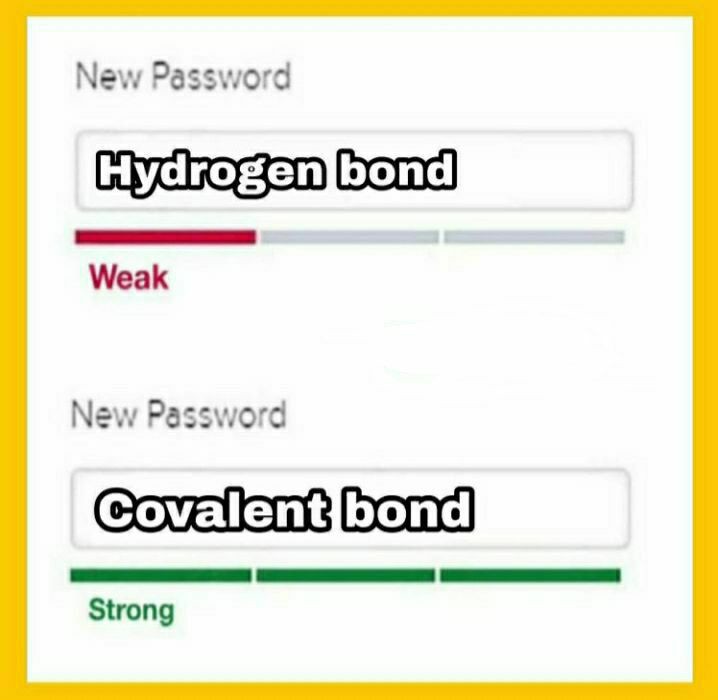
Oh, the chemical bond strength meter doesn't lie! Using "hydrogen bond" as your password? Might as well use "password123"! Those flimsy electrostatic attractions barely holding your molecules together are exactly like your weak security practices! Meanwhile, "covalent bond" gets the green bar of approval - sharing electrons like a proper digital fortress! Next time just use "metallic bond" and watch the password meter EXPLODE with confusion! 💥🧪

The Chemistry Of Bonds: Buff Doge vs. Cheems

The Chemistry Of Bonds: Buff Doge vs. Cheems
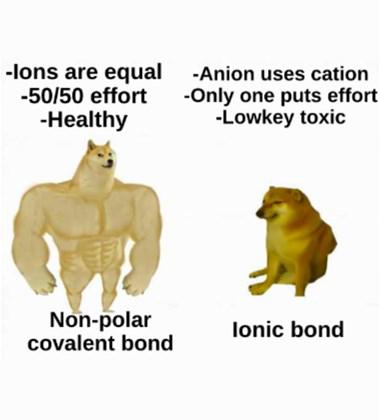
Chemistry bonds as gym bros! The muscular doge represents covalent bonds where atoms share electrons equally like perfect workout partners - both putting in 50/50 effort for those molecular gains. Meanwhile, the wimpy cheems is the ionic bond where one atom basically steals electrons from another. Talk about toxic relationship chemistry! One atom does all the work while the other just takes, takes, takes. No wonder ionic compounds are so salty about it!

Chemical 🅱️onds: The Bell Curve Of Understanding

Chemical 🅱️onds: The Bell Curve Of Understanding
The bell curve of chemical bond understanding is brutally accurate. In the middle, we have the chemistry teacher desperately trying to explain electron sharing while the students on both ends are just wondering "WTF is a bond?" The 34% of students with average intelligence grasp just enough to pass the exam before promptly forgetting it all. Meanwhile, the 0.1% on either end are either too confused to function or so brilliant they've circled back to confusion. Chemistry teachers everywhere are silently nodding in pain.

Chad Ionic Bonds vs Virgin Covalent Bonds

Chad Ionic Bonds vs Virgin Covalent Bonds
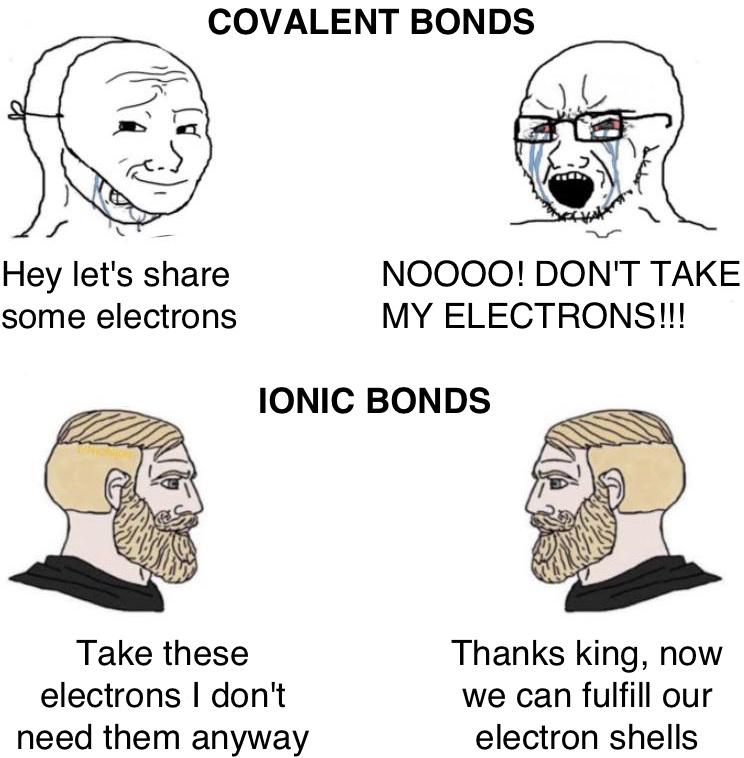
The eternal chemical drama between covalent and ionic bonds! Up top, we've got covalent bonds acting like that one friend who never learned to share properly. One atom desperately wants to share electrons while the other is having an absolute meltdown at the thought of giving up its precious negative charges. Meanwhile, the "Chad" ionic bonds below are having a civilized exchange. One atom casually tosses away electrons it doesn't need (looking at you, sodium), while the other graciously accepts them (hello, chlorine) to complete its outer shell. It's basically the difference between a chaotic kindergarten toy-sharing session and a sophisticated business transaction. Thirty years of teaching chemistry and I still can't get students to remember this without memes. Whatever works, I guess.

Atoms In Bonds

Atoms In Bonds
The chemistry dating scene is brutal! Covalent bonds are like those intense relationships where both parties refuse to let go of shared electrons, constantly tugging back and forth. Meanwhile, ionic bonds are the sophisticated sugar daddy arrangement of the molecular world - metals just casually donating electrons to needy non-metals without the drama. "Can I offer you a nice electron in this trying time?" is basically the pickup line every sodium atom uses on chlorine at the periodic table mixer.

Cold War Chemistry: How Political Systems Explain Atomic Bonds

Cold War Chemistry: How Political Systems Explain Atomic Bonds
The chemistry struggle is REAL! This meme brilliantly uses Cold War symbolism to explain chemical bonds. Ionic bonds are like America - "MY electrons" - where one atom basically steals electrons from another (capitalist style). Meanwhile, covalent bonds are the Soviet Union's "OUR electrons" approach, where atoms actually share their electrons (communist style). Chemistry teachers everywhere are secretly using this to help students remember the difference! Next time you're staring blankly at your chemistry homework, just remember: electrons are either privately owned or part of the commune!